
The short version: ChatGPT citations in personal finance do not last. Of the 215 pages it cited most in October 2025, 107 get no citations in September 2026, and the group kept 14% of its citations. Wikipedia and Reddit fell from 18% of top-500 citations to none. Bank, card issuer and government pages rose from 2% to 28%. Backlinks and ranking keywords still predict citations, but weakly.
We first ran this study in October 2025 and re-ran it on September 21, 2026 with the same method. The first version looked only at what predicts a citation. This one also asks a question we could not answer a year ago: once ChatGPT cites your page, how long does that last?
Key findings
- Citations decay fast. Of the 215 most-cited finance pages from October 2025, 107 (50%) get zero ChatGPT citations today. The group kept 14% of its citations. Only 8 pages grew.
- The source mix flipped. Wikipedia and Reddit held 77 of the top 500 cited pages and 18% of citations in October 2025. In September 2026 they hold none. Bank and card issuer pages went from 2% of citations to 22%. Government and regulator pages went from zero to 5%.
- Links and rankings still matter, modestly. Moving a page from the 25th to the 75th percentile in followed backlinks (16 to 595) goes with about 16% more citations. The same move in ranking keywords (19 to 477) goes with about 15% more.
- Domain Rating buys breadth, not per-page strength. Across 999 finance domains, DR 90+ sites took half of all citations because they had more pages cited (median 524 versus 188 for sites under DR 50). Their citations per page were no higher.
- Inside one trusted domain, links stop mattering. Across 1,000 Investopedia pages, referring domains showed no positive link to citations. Ranking breadth and demand for the topic did.
Our three measured factors explain 9% to 18% of the variation in citations, depending on the dataset. Most of what decides a citation sits outside classic SEO metrics.
Finding 1: half of last year’s most-cited pages now get nothing
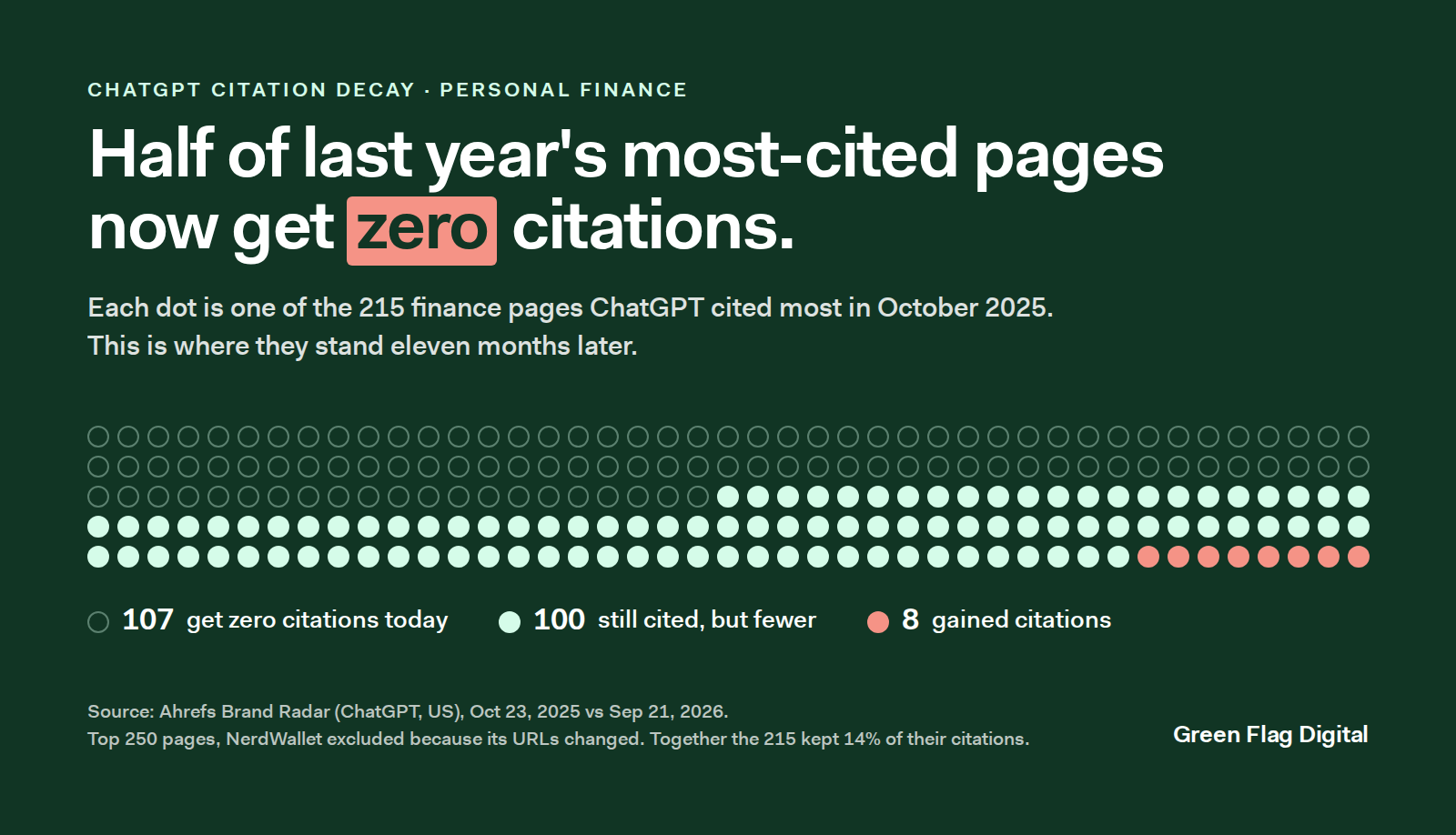
Only 34 of 435 pages (8%) from the October 2025 top 500 are still in the top 500 today. We then looked up today’s citation count for every one of the 250 most-cited pages from October 2025. NerdWallet moved its articles to new URLs during the year, so we set its 35 pages aside. That left 215.
| What happened to the 215 pages | Result |
|---|---|
| Get zero citations today | 107 pages (50%) |
| Lost 90% or more of their citations | 74% |
| Kept at least half | 22 pages |
| Gained citations | 8 pages |
| Total citations, Oct 2025 to Sep 2026 | 23,251 to 3,271 (14% kept) |
The losers share a pattern. Twenty of the 215 pages had 2024 or 2025 in the URL; 80% of those went to zero and together they kept 0.3% of their citations, against 16% for the rest. Dated pages died: Bankrate’s “high-yield savings rates today, May 19, 2025” went from 237 citations to zero. Annual awards pages died when the year turned: Kiplinger’s 2025 Readers’ Choice travel cards page fell from 421 to 3. Wikipedia entries vanished as a class.
The winners are living reference pages. Bankrate’s auto loan rates page rose from 193 to 342. Its best high-yield savings page rose from 102 to 198. Both are updated constantly and answer a question that never goes away.
| Domain | Pages tracked | Citations kept | Pages now at zero |
|---|---|---|---|
| Bankrate | 18 | 57% | 33% |
| Forbes Advisor | 16 | 42% | 12% |
| Kiplinger | 9 | 10% | 0% |
| Investopedia | 43 | 6% | 37% |
| Wikipedia | 41 | 1% | 76% |
| 8 | 0% | 88% |
Who took the space
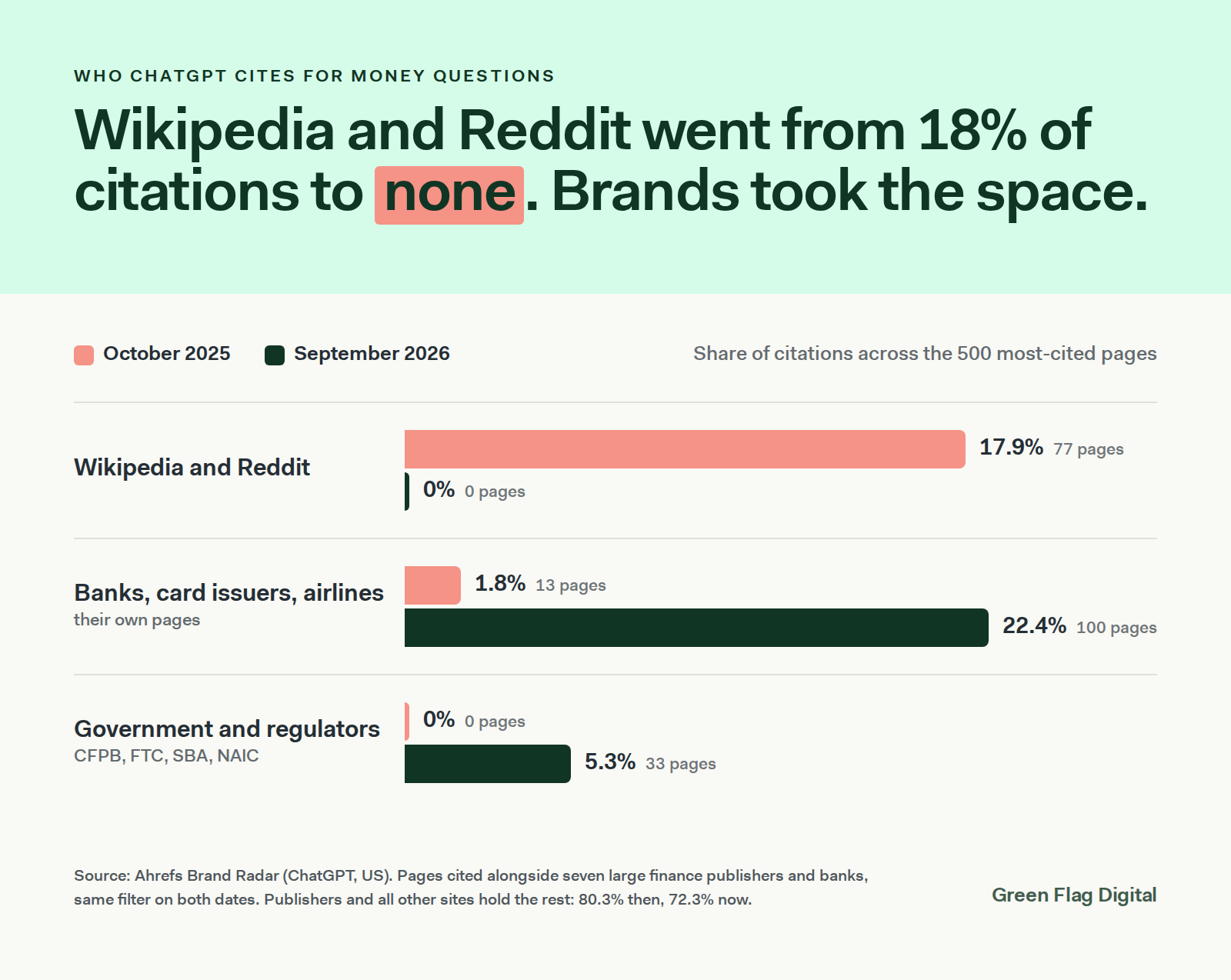
| Source type | Share of top-500 citations, Oct 2025 | Share, Sep 2026 |
|---|---|---|
| Wikipedia and Reddit | 17.9% (77 pages) | 0% (0 pages) |
| Banks, card issuers, airlines (first-party) | 1.8% (13 pages) | 22.4% (100 pages) |
| Government and regulators (CFPB, FTC, SBA, NAIC) | 0% | 5.3% (33 pages) |
| Publishers, affiliates and everyone else | 80.3% | 72.3% |
Chase alone went from 4 pages to 63 across its subdomains. The Wall Street Journal went from 5 pages to 23, nearly all of them Buy Side guides, and now holds the two most-cited pages in the set. Wikipedia is still cited heavily by ChatGPT in general. It has stopped appearing next to finance publishers in the answers we track.
What it means: a citation is rented, not owned. If the page carries a date in its URL or goes stale, expect to lose it within the year. And when someone asks ChatGPT about a Chase card, ChatGPT now goes to Chase.
Finding 2: links and rankings still predict citations, but weakly
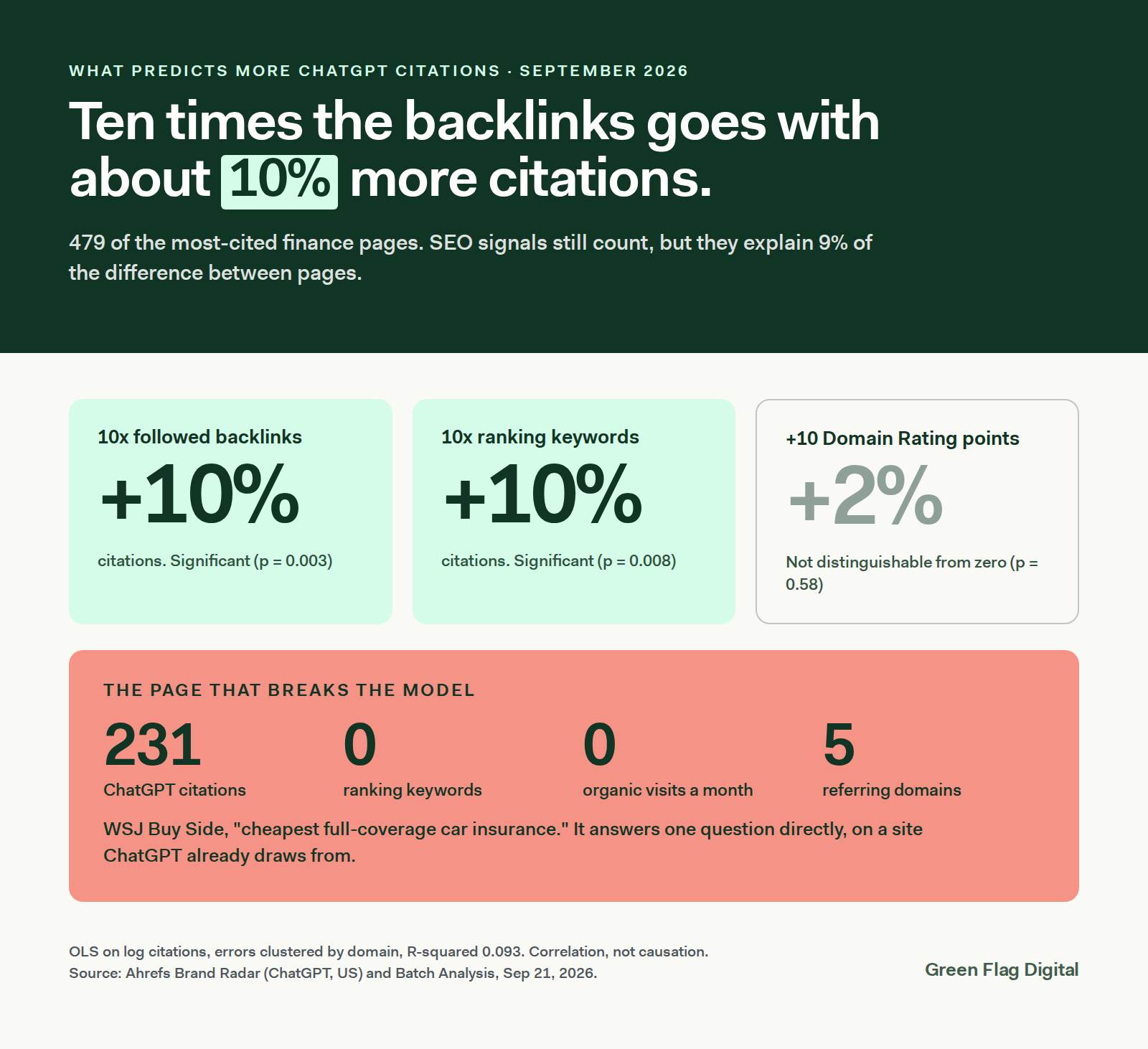
Followed backlinks and ranking keywords both predict more citations in the September 2026 data. Domain Rating no longer does. We ran the same regression as the original study on today’s 479 pages, after removing homepages and tracking-parameter duplicates.
| Factor | Coefficient | p-value | p-value, clustered by domain | Reading |
|---|---|---|---|---|
| Domain Rating | 0.0017 | 0.58 | 0.58 | No detectable effect |
| Ranking keywords (log) | 0.043 | 0.008 | 0.012 | 10x the keywords goes with about 10% more citations |
| Followed backlinks (log) | 0.042 | 0.003 | 0.031 | 10x the backlinks goes with about 10% more citations |
Compare that with October 2025. On the original 565 complete pages, Domain Rating carried a coefficient of 0.011 (p < 0.001) and backlinks 0.075 (p < 0.001). Keywords came in at 0.040 and lost significance once we clustered errors by domain (p = 0.135). R-squared was 0.15.
One caution on the DR result. The 2026 sample is the top 500 pages, and 91% of them sit on DR 80+ domains, so there is little DR variation left to measure. The honest reading is that DR works at the door: it helps a page get into the cited set. Once inside, it does not separate a page with 30 citations from one with 300.
The exceptions are the interesting part. A WSJ Buy Side page on full-coverage car insurance ranks for zero keywords in Ahrefs, gets zero organic visits, has 5 referring domains, and earned 231 citations. At the other end, awardmath.com (DR 0.2, one referring domain) earned 38 citations for a three-card comparison, and cruiseshiptracking.com (DR 7) earned 25 for a cruise cost guide. 22% of the 50 most-cited pages get under 100 organic visits a month.
What it means: links and rankings raise your odds. They do not explain the outcome. A page that answers the exact question, on a site ChatGPT already draws from, can win with almost no SEO footprint. That last sentence is our interpretation, not something the model proves.
Finding 3: Domain Rating buys breadth, not per-page strength
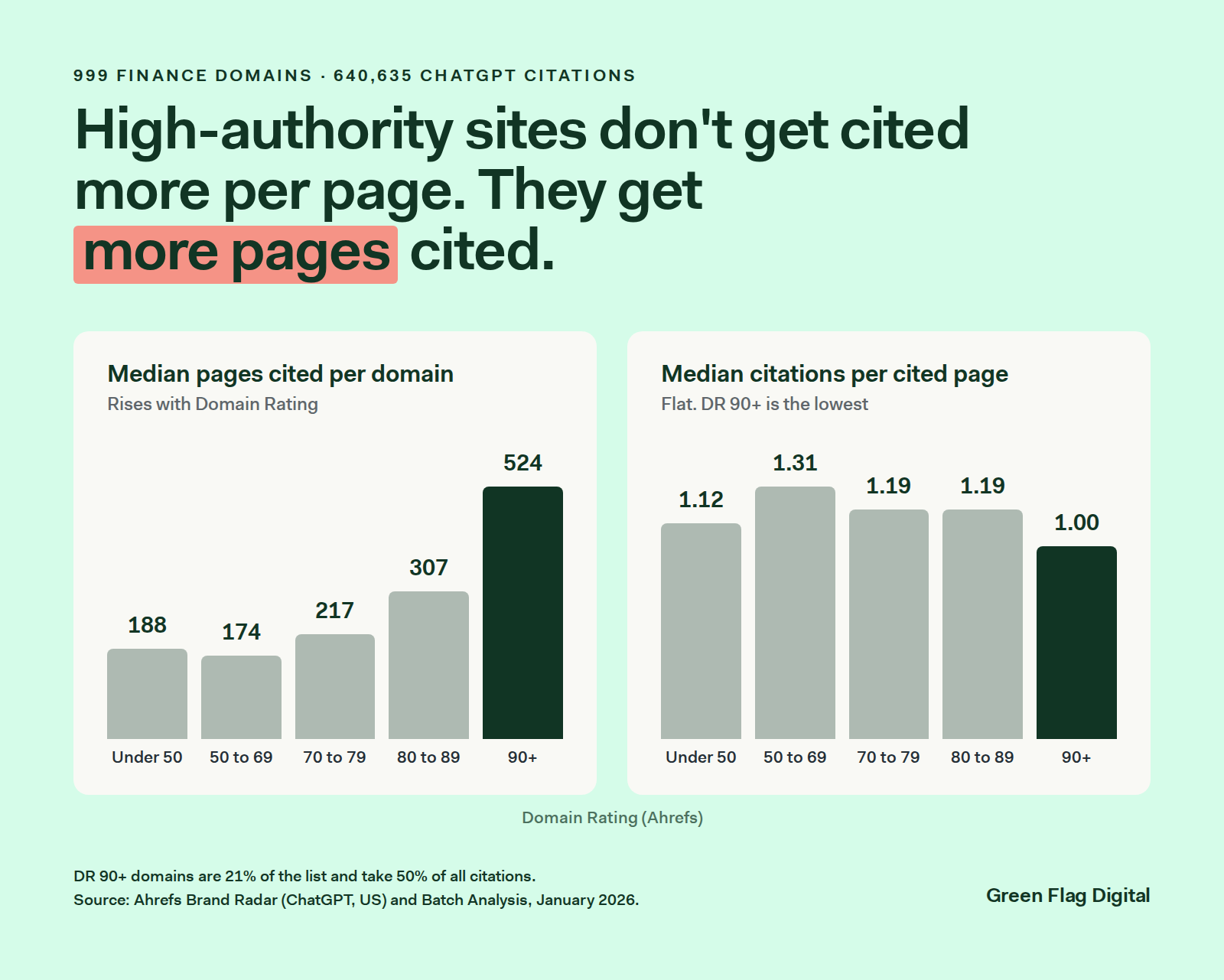
High-DR domains win because more of their pages get cited, not because each page gets cited more. We looked at 999 domains cited in ChatGPT answers about personal finance, budgeting, debt, investing, retirement and saving. Together they earned 640,635 citations.
| Domain Rating | Domains | Share of all citations | Median pages cited | Median citations per cited page |
|---|---|---|---|---|
| 90 to 100 | 211 | 50.2% | 524 | 1.00 |
| 80 to 89 | 282 | 23.0% | 307 | 1.19 |
| 70 to 79 | 279 | 16.9% | 217 | 1.19 |
| 50 to 69 | 126 | 5.7% | 174 | 1.31 |
| Under 50 | 101 | 4.2% | 188 | 1.12 |
DR 90+ domains are 21% of the list and take half the citations. Yet the correlation between DR and citations per cited page is slightly negative (Spearman -0.17). The correlation between DR and the number of pages cited is positive (0.41).
Small sites do break in. flavor365.com (DR 36) earned 1,101 citations across 1,020 pages. latestcost.com (DR 13, 22 referring domains) earned 565.
What it means: you will not out-authority NerdWallet. You can out-cover it on a narrow topic. Every page that answers a distinct question is another ticket in the draw, and low-DR sites with hundreds of specific pages are already collecting.
Finding 4: inside one trusted domain, links stop mattering
On a single DR 92 site, referring domains showed no positive relationship with citations. We took 1,000 cited Investopedia pages, which holds domain authority constant, and tested what separates them.
| Factor | Coefficient | p-value | n |
|---|---|---|---|
| Ranking keywords (log) | 0.25 | < 0.001 | 809 |
| Referring domains (log) | -0.07 | 0.008 | 809 |
| Days since last update (log) | -0.10 | 0.52 | 289 |
| Word count (log) | -0.03 | 0.91 | 289 |
| Number of H2 headings | 0.01 | 0.65 | 289 |
Ranking keywords were the only page-level factor that held up. Freshness, length and heading count did nothing measurable. The small negative sign on referring domains disappears once topic demand is added to the model (p = 0.16).
Topic demand is the big one. Adding the search volume of the questions each page was cited for lifts R-squared from 0.09 to 0.62. Treat that number with care: volume is summed across the prompts a page appears in, so part of the relationship is mechanical (our inference from how the export is built).
The most-cited Investopedia pages are not core finance explainers. They are brand breakdowns: the companies owned by LVMH (260 citations), the companies owned by L’Oreal (191), Lululemon’s business model (177), H&M versus Zara versus Uniqlo (141). A sneaker economics article with 4 monthly organic visits earned 107.
What it means: on a site ChatGPT already trusts, building links to one page will not move its citations. Picking a question many people ask, and ranking for the many ways they phrase it, will.
What to do with this
These are our recommendations. They follow from the data above, but they are practitioner judgment, not tested interventions.
- Treat citations as a recurring cost. Half of last year’s winners are at zero. Put your cited pages on a refresh calendar and check them quarterly.
- Keep dates out of URLs. Pages stamped “2025” or “May 19” lost nearly everything. The living rate tables and “best of” hubs on stable URLs are the ones that grew.
- Own the answers about your own product. First-party pages went from 2% of citations to 22%. If ChatGPT describes your card, plan or policy, it increasingly wants your page. Make sure a clear, current one exists for every product question.
- Build coverage before you build links to single pages. Authority shows up as more pages in the pool. One page per distinct question beats one long guide.
- Earn authority at the brand level. Domain-wide trust decides whether you are in the consideration set at all. That is a digital PR job, and it lifts every page at once.
- Stop counting on Wikipedia and Reddit mentions for finance topics. They carried 18% of citations in this set a year ago and none today.
Methodology
Citation counts come from Ahrefs Brand Radar, ChatGPT data source, United States. We did not query ChatGPT ourselves. SEO metrics come from Ahrefs Batch Analysis in URL prefix mode.
The page set. We asked Brand Radar for every page cited in a ChatGPT response that also cites at least one of seven anchor domains: NerdWallet, Bankrate, Bank of America, Chase, Credit Karma, The Points Guy and Investopedia. That returns the anchors’ own pages plus whatever ChatGPT cites beside them. We took the 500 most-cited pages, the most the API returns per call.
Two dates, one method. We ran the identical filter for October 23, 2025 and for September 21, 2026. To confirm this matches the original study, we compared the October pull with Max Snodgrass’s October 2025 export: 44 of his 50 most-cited pages appear in it, and the rank correlation on shared pages is 0.71.
The decay panel. For each of the 250 most-cited pages from October 2025, we requested today’s count directly using Brand Radar’s tracked URLs option. A page that returned nothing is counted as zero. We excluded 35 NerdWallet pages because the site changed its URL structure during the year, which would read as false decay.
The models. Ordinary least squares on the log of citations, with Domain Rating, log ranking keywords and log followed backlinks. Counts use log(1 + x) so pages with zero keywords or backlinks stay in. We report standard p-values and p-values clustered by domain, since pages on one site are not independent. From the 2026 set we removed 8 homepages and 13 tracking-parameter duplicates, leaving 479 pages.
The supporting datasets. The 999-domain sheet and the 1,000-page Investopedia set were exported from Brand Radar and Batch Analysis by Max Snodgrass in January 2026. The Investopedia content fields (word count, H2 count, last-modified date) cover 353 of the 1,000 pages.
Reproduce it. Download the data (Excel, 143 KB). The workbook holds the 2026 refresh (500 pages, 31 columns), both top-500 lists, the 250-page decay panel, and a claims ledger that maps the numbers in this article to the rows and formulas behind them.
What this data cannot tell you
- Correlation only. Nothing here shows that adding backlinks causes citations. Pages that earn links also tend to be better pages.
- Cited pages only, in the regressions. Every page in the models was cited at least 20 times (2026) or 3 times (2025). The models describe what separates more-cited from less-cited pages. They do not describe what gets a page cited in the first place. The decay panel is the one place we observe true zeros.
- One vendor’s view of ChatGPT. Brand Radar runs its own prompt set. A change in its prompts or collection between our two dates would look like a change in ChatGPT. We cannot separate the two. Pulling October 2025 today also returned counts about twice as high as the export made at the time, so either Ahrefs has revised its history or the original export used a narrower filter.
- The sample leans toward seven anchors. Pages are included because they were cited next to one of seven large finance brands. Chase and Bank of America are two of those anchors, so part of the first-party rise reflects our own filter. The filter was identical on both dates, so the change is real within it.
- Finance only, United States only. Money topics are high-stakes, and ChatGPT may treat them more conservatively than other subjects.
- URL changes hide as decay. We caught NerdWallet’s migration and removed it. Smaller moves on other sites may remain in the zero count.
- Low explanatory power. R-squared runs from 0.09 to 0.18. More than 80% of the variation in citations is unexplained by authority, links and rankings.
FAQ
What factors increase the likelihood of being cited in ChatGPT answers?
In our finance data, followed backlinks and the number of keywords a page ranks for both predict more citations. Ten times the backlinks goes with about 10% more. Being on a domain ChatGPT already cites matters more than either, and topic demand matters most.
Does Domain Rating affect ChatGPT citations?
At the domain level, yes: DR 90+ sites took 50% of citations across 999 finance domains. At the page level, no: those sites earned no more citations per page, and DR had no detectable effect among today’s top 500 pages.
How long does a ChatGPT citation last?
Not long. Half of the 215 most-cited finance pages from October 2025 had zero citations eleven months later. The 20 pages with 2024 or 2025 in the URL fared worst: 80% went to zero and the group kept 0.3% of its citations.
Does ChatGPT still cite Wikipedia and Reddit?
In general, yes. In the finance answers we track, they went from 77 of the top 500 pages to none.
Can a low-authority site get cited?
Yes. Seven pages in today’s top 500 sit on domains under DR 60, including three under DR 10. Each one answers a narrow question directly.
Update log
- Sep 21, 2026: Full re-run with fresh data. Added the 11-month decay panel, the source-mix comparison, the 999-domain analysis and the Investopedia analysis. Corrected the sample size, added model fit and clustered errors, and added a limitations section. Moved from our research section to the blog.
- Mar 9, 2026: Added key takeaways and updated visuals.
- Jan 9, 2026: First published, using October 2025 data.
Cite this study: Green Flag Digital, “We tracked the finance pages ChatGPT cited most. Eleven months later, half of them get zero citations.” September 21, 2026.





Leave a Reply