
Answer engine optimization (AEO) is the practice of making your brand the source an AI system cites or names when it answers a question, across Google AI Overviews and AI Mode, ChatGPT, Perplexity, Gemini, Copilot, and the agents built on them. SEO earns a ranking and a click. AEO earns a mention inside the answer, whether or not anyone clicks.
That’s the definition. What it leaves out is that most of the citations you’ll ever earn won’t point at your website. They’ll point at the places that talk about you. I run a digital PR agency, so I have a bias here, and I’m going to show you the data behind it rather than ask you to trust me.
Key takeaways
- AEO is getting cited or named inside AI answers. SEO is getting ranked and clicked. Same foundation, different scoreboard.
- Ranking and citation are decoupled. We pulled AI citation counts for every publisher in our guide set. The longest, best-credentialed guide sits on a domain with 11.
- All eleven guides agree on the same 20 practices. They’re in one table below so you can stop reading guides.
- Most citations for most brands come from pages the brand doesn’t own: Reddit, YouTube, G2, trade press, Wikipedia. None of the eleven explains how to earn those.
- Where to start is a map, not a checklist: your buyer questions, your customer types, your offers, and where each claim about you is already corroborated.
Who is this guide for?
I wrote it for four people I talk to every week.
The founder who built an internet business on search traffic and watched the curve bend. You know what AEO is. You want to know what to stop doing.
The partner at a wealth management firm or a law practice whose next client will ask ChatGPT for a shortlist before asking a friend. You never had to think about search engines. Now you have to think about answer engines.
The marketing leader inside a B2B software company, whether that’s the global SEO lead, the product marketer or the CMO, who’s being asked “are we in ChatGPT?” in a board deck and needs a defensible answer by Friday.
And the CEO of a $50 million company who has read three of these guides and still can’t tell what to fund. There are roughly 200,000 middle-market companies in the United States, and most of them are where you are.
How I wrote this
Before writing a word, I read the ten guides a search for “what is answer engine optimization” put in front of me that week: HubSpot, Semrush, Amsive, Siege Media, Profound, Digiday, Coursera, Quid, and Directive twice (a guide and a service page, because the service page is what a buyer clicks). Then Hobo Web’s 8,500-word history of Google answers. We pulled out 225 factual claims and 326 recommendations, graded every claim by its evidence, and tagged every tip.
Two things fell out. 45 percent of the claims cite nothing, and only 8 percent link to a primary source. And all eleven recommend the same core practices while almost none of them practice those on the page you’re reading.
Search has promised “just the answer” before
If you’ve been in this industry more than a few years, the current panic has a familiar rhythm. Ask Jeeves promised natural-language answers in 1997 and delivered links. Knowledge Graph and featured snippets, 2012 to 2014, taught a generation of SEOs to chase “position zero.” Then voice. From 2016 to 2019 every conference deck carried some version of “half of all searches will be voice by 2020.” I sat in those rooms. It never happened, and the companies that rebuilt their content for Alexa got nothing for it.
I pulled ten years of search demand for “voice search optimization” and set it beside three years of “answer engine optimization.” Voice never left its band. AEO went from 38 searches a month in January 2023 to a peak above 6,000 in March 2026. So I owe you a reason I believe this one when I didn’t believe voice.
People are already doing it. Pew Research found 34 percent of American adults had used ChatGPT by June 2025, double the 2023 share. Google put AI Overviews in front of every US user in May 2024 and AI Mode in May 2025. And on September 8, 2026, Meta launched Muse, a personal AI agent that, in Meta’s words, “actually does the work”: booking, filling forms, buying. Free tier, $20 a month for Power, $100 for Maximum.
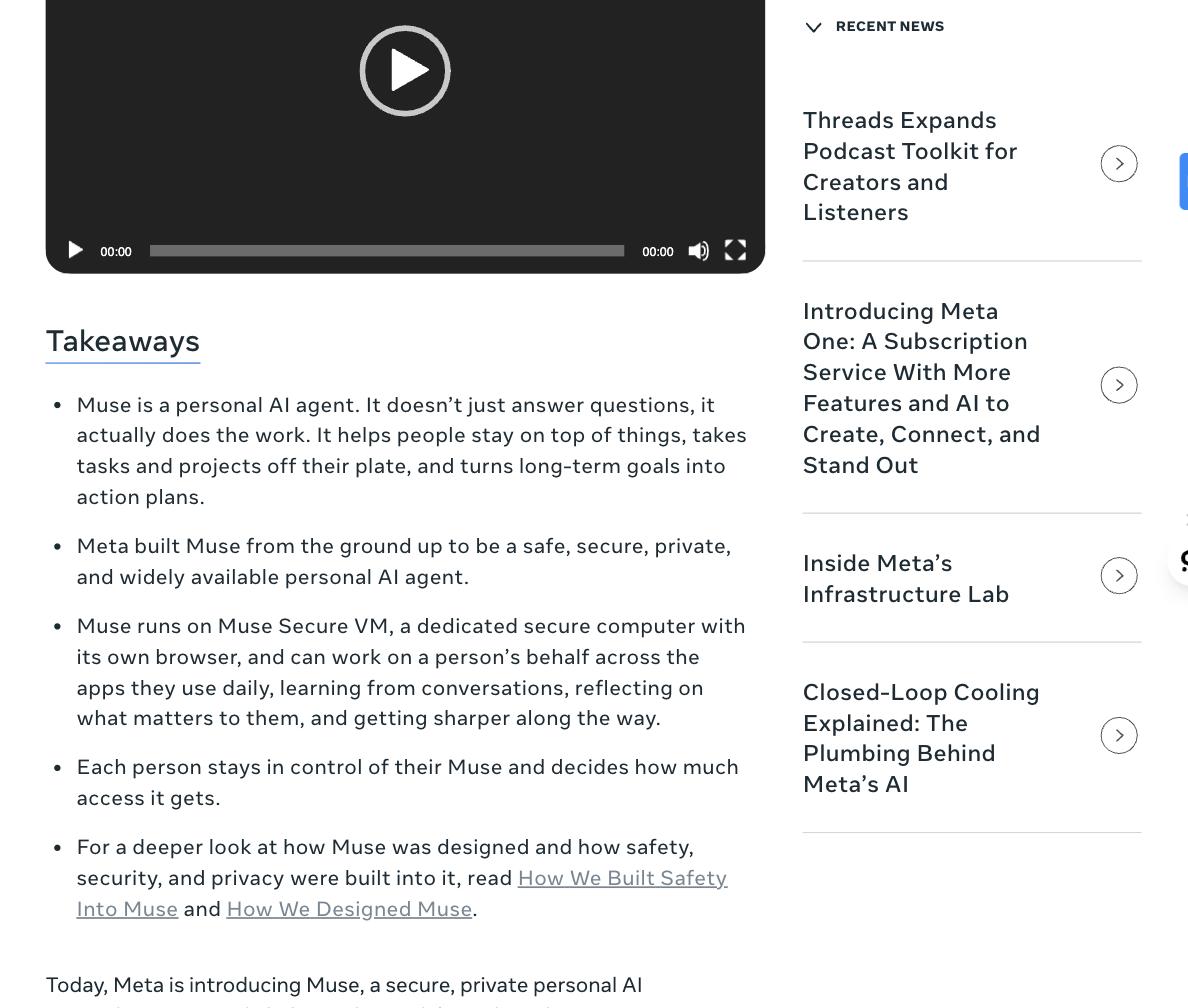
Muse matters here for one reason. When an agent chooses a vendor on someone’s behalf, being the cited source stops being a visibility metric and becomes the sale.
Entities, structure, trust, and corroboration by other people carried forward from every era. Three things are new: retrieval is probabilistic and differs by engine, the answer surface isn’t a page you can rank, and the sources engines lean on are mostly sites you don’t own. Hold onto that last one.
What is the difference between AEO, GEO and SEO?
GEO, AEO, LLMO and “AI search optimization” describe the same job. Ahrefs shows “generative engine optimization” spiking to almost 16,000 US searches a month in mid-2025 and settling, while “answer engine optimization” climbed slower and held. Use whichever term your board uses.
The distinction that matters is between three jobs.
| SEO | AEO | Agentic (new) | |
|---|---|---|---|
| Goal | Rank and get the click | Be cited or named in the answer | Be the option the agent selects and acts on |
| Unit | Page | Passage, entity, claim | Product data, availability, trust signals |
| Trust signal | Links and authority | Corroboration across sources | Corroboration plus verifiable facts (price, stock, terms) |
| Metric | Rankings, clicks | Citations, mentions, share of voice | Inclusion in decisions, actions taken |
Ranking and citation are decoupled. A page can sit at #1 and never get pulled into an answer. Google’s own guidance says the foundation still matters: “The best practices for SEO remain relevant for AI features,” and “you don’t need to create new machine readable files, AI text files, or markup.” That sentence retires a lot of the advice in this category.
Ranking for “what is AEO” and being cited by AI are different games
I wanted proof of that decoupling, so we pulled it. Ahrefs tracks how often six AI platforms cite each domain. Here’s every publisher in the set, with HubSpot added because it ranks #2 for “answer engine optimization” and sits inside Google’s AI Overview for it.
Amsive’s guide is 8,300 words, co-authored by Lily Ray. It sits at #12 for the query in Ahrefs’ snapshot, and its entire domain has 11 AI citations. HubSpot ranks #2 for “answer engine optimization” and has about 29,800 across the six platforms. Semrush doesn’t crack the top 15 for either query and has 28,505. Profound, a tool vendor, gets 76 of its 104 from ChatGPT alone, which tells you the engines have different diets. My own agency’s site has 103. I mention it so you know I’m not grading from the sidelines.
Then I asked Google AI Mode the question.
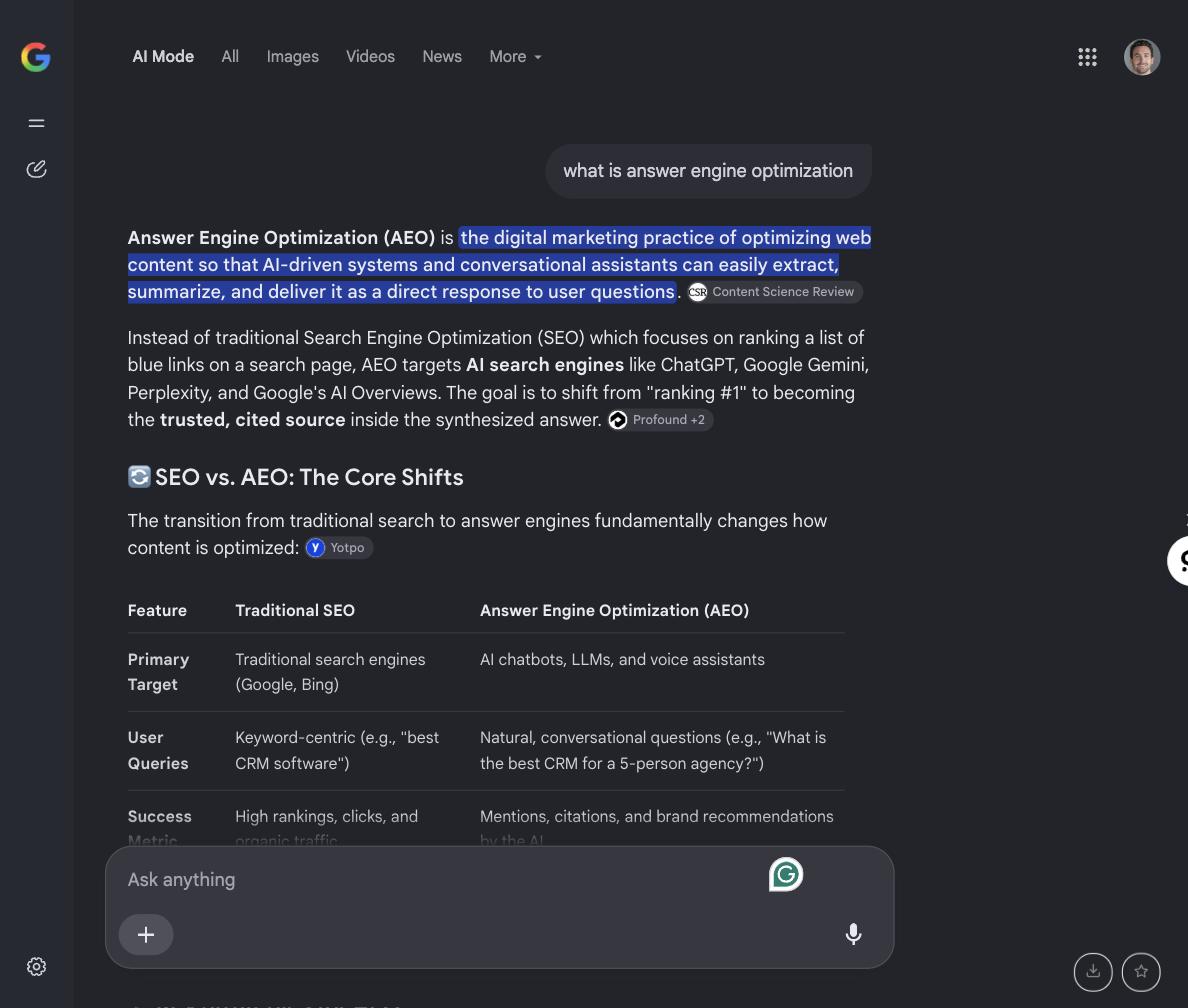
It cited Content Science Review, Profound, and Yotpo. Amsive, Semrush and HubSpot, the three biggest names in the set, were nowhere in the answer. If you’re the SEO lead at a software company, this is the slide for your next board meeting: the page that ranks and the page that gets cited aren’t the same page, so you have to measure both.
How does an answer engine pick a source?
Most guides skip the mechanics. Four ideas are enough to reason about the rest.
Training isn’t retrieval. The model memorized years of the open web, Wikipedia, Reddit, books. When you ask it something specific or recent, it also fetches live pages through a search index: Bing for ChatGPT, Google for Gemini. Being in the training data gets you known. Being retrievable gets you cited today. Two of the eleven guides blur the two, and bad advice follows.
Retrieval, citation, mention and recommendation are four separate events. A page can be retrieved and not cited; a brand can be mentioned when none of its pages were retrieved. Chris Green put it well in Search Engine Journal this month: “If your URL comes back, retrieval isn’t your problem.” Find the step you’re failing before you fix anything.
The unit is the passage, not the page. AI Mode uses what Google calls query fan-out: one question becomes many sub-questions, each answered from short blocks of text. The paragraph that answers a sub-question cleanly is what gets lifted. A 4,000-word page with the answer in paragraph 31 loses to a 600-word page that states it in paragraph one.
Every engine eats differently. You can see it in the Ahrefs table: Perplexity is the heaviest citer for most of these domains, ChatGPT favors Profound, AI Mode leans on Directive and Hobo Web. Profound’s research, as reported by AdAge in 2025, found ChatGPT citing Wikipedia in nearly half its responses while Perplexity leaned on Reddit at a similar rate. Those shares move monthly. Build a footprint several engines can find.
The consensus checklist
Here’s what every guide agrees on, compressed, because you can get the long version from any of the other ten and most of it is the SEO you should’ve been doing anyway. We keep a fuller version in our AEO best practices post.
| Practice | Guides that recommend it | Why it works |
|---|---|---|
| A 40-to-60-word direct answer in the first paragraph | 10 of 11 | The passage is the unit of retrieval |
| Question-shaped H2s and a real FAQ | 9 of 11 | Prompts are questions; match them |
| Lists, tables and comparisons | 10 of 11 | Structured blocks are the easiest to lift |
| One idea per paragraph | 9 of 11 | Fan-out reads paragraphs, not pages |
| Article, Person, Organization and FAQPage schema | 9 of 11 | Machine-readable facts about who wrote what, when |
| Visible dates plus dateModified | 7 of 11 | Recency is a retrieval filter |
| Named authors with credentials, sources linked inline | 9 of 11 | The GEO study found citations and statistics lifted visibility up to 40 percent |
| Let AI crawlers in, render server-side, load fast | 7 of 11 | Login walls and JavaScript-only pages don’t get cited |
| Keep the SEO foundation | 11 of 11 | Retrieval starts from an index |
Do all of it. It’s table stakes. Then look at what the same guides do on their own pages.
Eight of the ten guides recommend schema. Three ship Article schema on the article. Six have an FAQ section; none mark it up as FAQPage. HubSpot’s guide tells you to display update dates and author names, and its own page shows neither. I’m not saying this to embarrass anyone. The gap between advice and practice is where a smaller brand wins. This page has Article, Person, Organization and FAQPage schema, visible dates, my byline, and a source link on every number.
Why won’t most of your citations come from your site?
Amsive says it in one line and moves on: “oftentimes it’s not your website that’s going to be cited.” Quid, a research vendor, says it better: “consensus matters more than any one source being loud.” Nine of the eleven guides tell you to get mentioned on third-party sites. None explain how a mention gets earned. This is the section the article exists for.
An LLM can’t verify your homepage. It can check whether the same claim about you shows up in places it already trusts. A claim on your site is a hypothesis. The same claim on G2, in a trade publication, in a Reddit thread and in a “best X for Y” roundup is a fact. Think of a résumé versus references. Nobody hires on the résumé alone.
There are five layers, and they feed each other in roughly this order.
- The data asset. An original study, a benchmark, a calculator: something on your site other people would want to cite. Without it the other four layers have nothing to repeat.
- Press. Coverage in the publications the engines already cite for your category. This is digital PR for AI search, and it’s the only layer where you control the timing.
- Roundups and reviews. “Best X for Y” lists, G2, Capterra, Clutch. Profound’s data, via AdAge, put G2 in the top four ChatGPT sources; a SEOMator analysis of 177 million citations found listicles were about a third of them. Vendor estimates, but the direction is consistent.
- Community. Reddit, YouTube, Quora, your industry’s forum. Perplexity’s biggest source. You earn it by being useful in threads, never by seeding them; Reddit was removing roughly 25,000 spam posts a day in early 2026, per eMarketer.
- Reference. Wikipedia, Wikidata, Crunchbase, the industry directory. The engine’s “who are you” lookup. Consistent name, category, description and founding facts, everywhere.
The one real worked example in all eleven guides comes from Semrush. They published an original study of 10 million keywords on how often Google shows AI Overviews. It got shared on Reddit, picked up by newsletters and linked more than 1,900 times. Now ask ChatGPT how common AI Overviews are. It cites Semrush. That’s the whole supply chain, end to end, and Semrush never wrote a “how to optimize for AI” paragraph to make it happen. I wrote up how we run that loop for clients if you want the mechanics.
If you’re the founder with an internet business, you already have data: product usage, a survey base, pricing history. Publish one study a quarter and pitch it. If you’re the wealth management or law firm partner, your data asset is smaller and closer to home: a benchmark of fees in your metro, a plain-English guide to a rule change, a calculator. Your press layer is the local business journal and the association newsletter, and your review layer is Google Business Profile and the advisor or bar directories. Same machinery, with nearer outlets.
Map it: topics, customer types, offers, and where you’re already believed
Every guide tells you to “optimize your content.” That’s a page-level instruction for a claim-level problem. What I use with clients is a map.
The rows are the 20 to 40 questions your buyers ask, pulled from sales calls, support tickets, People Also Ask, Reddit and your visibility tool’s prompt research. The columns are your customer types. For a cybersecurity software company that’s the mid-market CISO, the fintech security lead, the MSP owner and the healthcare IT director. For a wealth manager it’s the pre-retiree, the business owner and the recent widow.
Each cell holds three things: the offer that answers this question for this customer type, the one-sentence claim you want the engine to repeat, and a corroboration score, meaning how many of the five layers already state that claim about you.
Then you read the map three ways.
Cells where you shine have a strong claim, corroborated on three or more layers, with thin competition. Publish and promote here first. Presence is most of the battle, and here you already have it.
Cells where you’re loud but alone have a strong claim on your site and zero corroboration anywhere else. That’s your digital PR target list, in priority order.
Cells where you’re absent are questions your best customers ask that you have no offer for. That’s a product decision, not a content decision, and it’s the most valuable thing the map will tell a CEO.
For the $50 million CEO deciding what to fund: fund the map before the content. It costs a week. It tells you whether your problem is on-page structure (cheap), off-site corroboration (a PR program), or positioning (a leadership conversation). Most companies I run this with find their problem isn’t the one they came in with. And if you do nothing, the map still gets drawn. A competitor draws it, and the engines learn their version of your category instead of yours.
What should you measure?
The metric you were raised on, organic sessions, is one rung on a longer ladder now.
Retrieved, cited, mentioned, recommended, referred, pipeline. Six events, and most dashboards report exactly one of them.
Start with the free sources. Google reports AI Overviews and AI Mode traffic inside the “Web” search type in Search Console, not as a separate report, so build a branded-query view there. Bing Webmaster Tools launched an AI Performance report in public preview in February 2026. Add a GA4 referrer filter for chatgpt.com, perplexity.ai and gemini.google.com. Then pick one paid tracker and stick with it: Ahrefs Brand Radar, Profound, Semrush’s AI Visibility Toolkit, HubSpot’s $50-a-month AEO tool, Peec, Scrunch. A stable prompt set and a monthly cadence matter more than the brand on the invoice. Our working list of AI ranking factors has the prompt-set template we use.
HubSpot’s guide contains the single most useful diagnostic in the eleven: if mentions are rising but citations are flat, fix structure and retrievability. If citations are rising but referrals are flat, your tracked prompts don’t match what buyers ask.
Be careful with conversion claims. Semrush reports AI search visitors as 4.4 times more valuable than organic visitors; HubSpot reports AEO-sourced leads converting three times better. Both are the vendors’ own program data with no published method. Say “Semrush reports,” never “studies show.”
What’s overrated right now?
llms.txt. Three of the eleven guides push it. Google’s guidance says you don’t need AI text files, and no major engine has confirmed reading one. Harmless, not a lever.
Adding the year to your title. Freshness matters, and AirOps reports 95 percent of ChatGPT citations go to content updated within ten months, but changing “2025” to “2026” in a title tag without changing the page isn’t an update. The engines will work that out, and so will your readers.
Writing “for the AI.” The chunking advice is real, but prose written for a parser reads badly to the buyer who does click. Write for one person and structure it for the machine.
Chasing every engine. Pick the two your customers use. For most US B2B companies that’s Google’s AI features and ChatGPT. Nobody I work with needs a Grok strategy yet.
Your first 30 days
Week one: write down 25 questions your buyers ask. Run them by hand on two engines and screenshot who gets cited. Unglamorous, and the most important hour you’ll spend.
Week two: build the corroboration map. Score every cell.
Week three: fix the ten pages that already rank for your “shine” questions. Direct answer up top, question headings, FAQ, schema, visible dates, real byline.
Week four: ship one data asset aimed at your “loud but alone” cells and pitch it to the five outlets that got cited in week one.
Then set the baseline in Search Console and one tracker, and re-run the 25 questions monthly. Every guide asserts a timeline for results and none has published data on it. What I can tell you from our own clients: pages that already rank move within weeks, and the off-site layers take a quarter or more.
Frequently asked questions
Does AEO replace SEO?
No. AEO is a layer on top of SEO and depends on the index underneath it. Google’s guidance is explicit that the same best practices apply. Pages that aren’t crawlable and indexed don’t get cited, however well they’re formatted.
What is the difference between AEO and GEO?
Two labels for the same job: getting cited or mentioned inside AI-generated answers. “Generative engine optimization” comes from a 2023 academic paper; “answer engine optimization” is the older marketing term. Use whichever your team already says.
How long does it take to see AI citations?
Nobody has published reliable timeline data, including the guides that promise “weeks.” In our client work, pages that already rank can appear in AI answers within a few weeks of restructuring. Earning citations from press, reviews and community takes a quarter or more.
Can a small brand beat a household name in AI answers?
Yes, in narrow cells. Engines don’t rank brands by size or ad spend; they cite the source that most clearly and consistently answers the specific question. A regional wealth manager with a plain-English guide to a rule change, corroborated in the local business press, can beat a national firm for that question.
What does an AEO program cost?
It depends on which layer is broken. On-page fixes for existing pages are cheap and fast. A corroboration program (digital PR, reviews, community) is a monthly retainer, and the price scales with how many “loud but alone” cells your map shows. Start with the map. It tells you what you’re buying.
Where do you stand?
If you want to know which layer is weakest for your brand, the Citation Gap Score takes two minutes: your top three buyer questions, whether you’re cited on two engines, a claim on G2 or in a roundup, press in the last twelve months, Reddit or YouTube presence, a Wikipedia or Wikidata entry, and whether your best page has schema and a byline. You get a score out of 100 and the weakest layer, named.
If you’d rather build the map yourself, the Corroboration Map template is a Google Sheet with the prompt sources, the five scoring columns, a worked example, and a tab that sorts your “loud but alone” cells into a PR target list.




Leave a Reply