Travel brands are going bigger, bolder, and more opinionated with their trend and “state of” reports, and honestly, that’s exactly what the industry needs right now. In a crowded content landscape, the strongest reports aren’t just summarizing data; they’re shaping how travelers, partners, and the press think about what’s next.
This post breaks down 10 standout travel trends and state-of-report examples that our team collected at Green Flag Digital (GFD). These aren’t just PDFs collecting dust; they’re interactive hubs, PR-ready insights, and search-friendly assets designed to drive authority and conversation.
Below, we’ll highlight what each company did well, why it works, and what we’d borrow (or tweak) if we were building something similar.
Key Takeaways
- The best travel trend reports blend first-party data + cultural insight, not just predictions.
- Interactive design and modular landing pages dramatically increase report longevity and shareability.
- AI-driven travel planning is no longer a “future” trend. It’s table stakes for 2026.
- Travelers are designing trips around identity, passions, and rituals, not destinations alone.
- Reports that pair strong storytelling with clear distribution angles are best positioned for PR pickup and organic search.
1. Booking.com
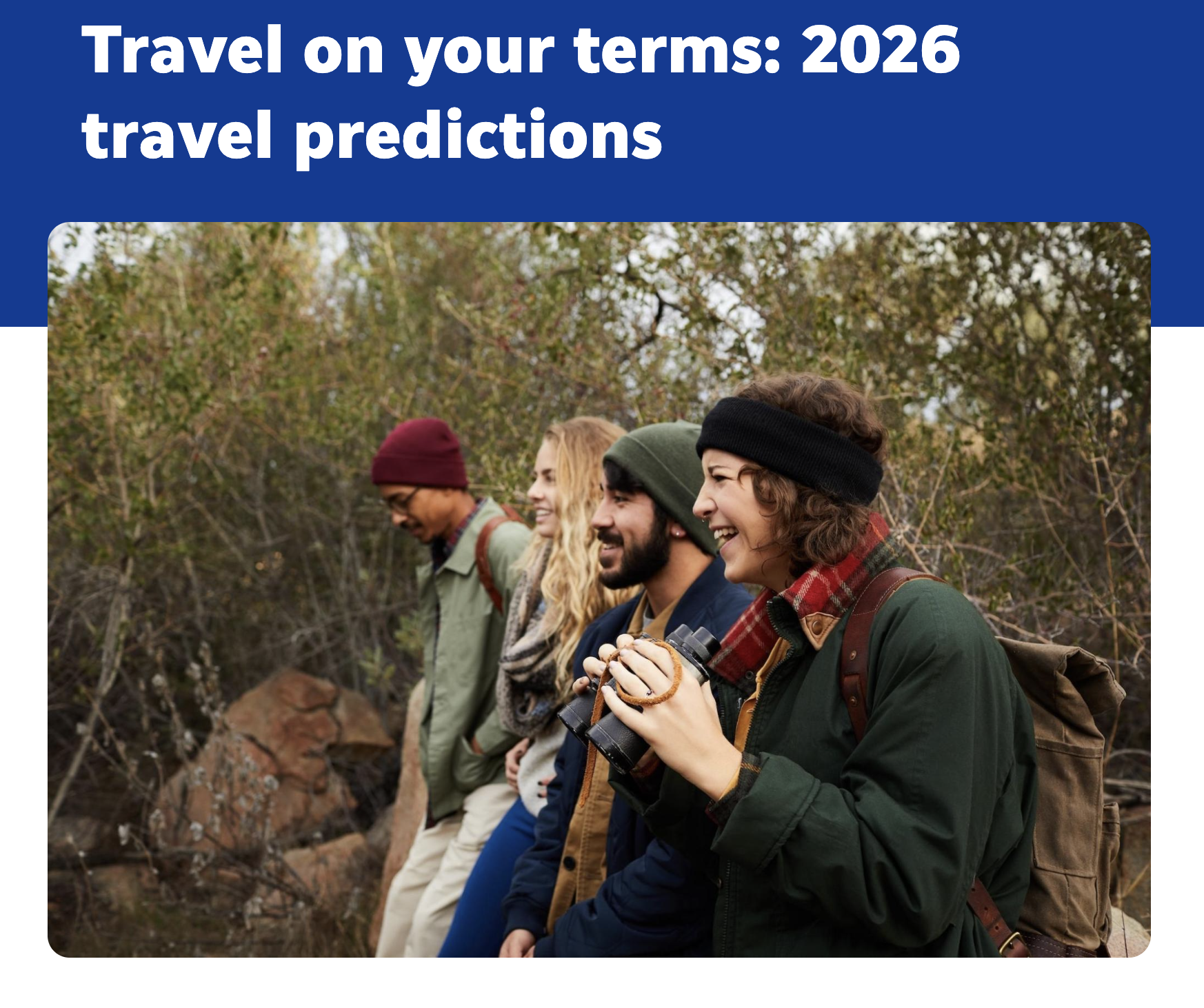
2026 Travel Predictions is Booking.com’s annual trends report, powered by insights from over 29,000 travelers across 33 countries and territories. The report explores how travel in 2026 reflects identity, relationships, wellness, and emerging technology.
This report stands out for its unexpected, highly quotable stats—from AI-powered carpool matching to glowcations, romantasy travel, and even robot hosts. It feels culturally plugged-in and genuinely fun to read, which makes it incredibly PR-friendly.
Here’s what they do best:
- Use surprising stats that journalists can lift directly.
- Frame trends around human behavior, not just destinations.
- Don’t shy away from niche or “weird” insights—they’re what people remember.
- Global sample sizes strengthen credibility and media trust.
- Tie trends back to product evolution without making it salesy.
Booking.com proves that a trends report can be playful and authoritative, which is a powerful combo for earned coverage and long-term brand authority.
2. Skyscanner
Skyscanner’s 2026 Travel Trends report explores 11 major trends shaping how people travel, supported by a survey of 2,000 U.S. travelers and enriched with search data.
Each trend has its own dedicated landing page, supported by beautiful visuals and statistics. This modular approach is excellent for SEO, internal linking, and distribution across multiple channels.
Here’s what they do best:
- Create individual URLs for each trend to capture long-tail search demand.
- Pair quantitative data with cultural framing.
- Lead with passions and rituals, not just locations.
- Use strong visual identity to elevate perceived value.
- Design reports for both scanning and deep reading.
Skyscanner’s approach shows how a trends report can double as a content hub, not just a one-off campaign.
3. KAYAK
The WTF (What The Future) Report is an interactive, scroll-driven experience exploring the future of travel through bold, almost sci-fi predictions.
This report is a masterclass in interactive storytelling. Each trend is paired with motion, visuals, and playful copy that feels distinctly “KAYAK.”
Here’s what they do best:
- Interactivity increases dwell time and memorability.
- Bold naming (Vitamin T, Feedbooking, LIT Travel) boosts shareability.
- Lean into your brand voice, don’t neutralize it.
- Speculative trends can still feel credible with clear framing.
- Design can be the differentiator in saturated report formats.
KAYAK shows that not every trend report needs to be conservative to be effective.
4. Expedia Group (Expedia, Vrbo, Hotels.com)
Unpack ’26 Travel Trends combines insights from 24,000 respondents, 18 countries, and 70+ PB of first-party data.
The scale, interactivity, and multi-brand collaboration give this report serious authority. Each trend has its own landing page, supported by video, data, and examples.
Here’s what they do best:
- First-party data is a massive credibility lever.
- Separate landing pages = better SEO + PR angles.
- Blend inspiration with concrete examples (hotels, destinations).
- Visual storytelling matters at enterprise scale.
- Sports, fandom, and pop culture travel are PR gold.
This is how enterprise brands turn research into a flagship content asset.
5. Airbnb

Airbnb’s 2026 Travel Predictions is a concise snapshot of what’s ahead for travel trends and popular destinations, designed for fast consumption.
Immediate key takeaways at the top make this report incredibly accessible (it’s a best practice to lead with them). It’s ideal for readers who want insight without committing to a long read.
Here’s what they do best:
- Lead with summaries for skimmability.
- Short-form reports, when done well, can still earn coverage.
- Talk about the experiences people are craving in travel, rather than just the destinations.
- Use trending terms like “touching grass” to connect with readers.
- Use strong headlines like “Travelers are swapping plus-ones for passports”.
Not every report needs depth; sometimes clarity and speed win. However, Airbnb is a large brand, and we’d recommend adding a few more data visualizations to showcase your findings.
6. Takeup
The Rise of AI-Planned Travel in 2026 explores how U.S. travelers are using AI to plan and book trips.
It’s straightforward, stat-heavy, and focused on a single theme: AI adoption. The data is immediately useful for hotels and travel brands.
Here’s what they do best:
- Takeup uses neat data visualizations that match their brand colors—creating consistency. It’s an easy way to make your report look more “put together”.
- Add a “word from our CEO” to the beginning of your report to signal that the report matters at the highest level and the data is backed by real decision-makers. It also helps humanize the brand.
- A comprehensive, downloadable report is paired with a brief landing page that pulls apart the most interesting stats (a good balance is to have both).
- Add a unique perspective—not only does Takeup talk about AI users in travel, but they also discuss the non-user perspective (what is holding non-users back?)
This report is a great example of a deep dive into a single theme (AI) within Travel. Rather than creating an overwhelming, bulky landing page, Takeup writes a brief post highlighting the report’s key takeaways, then encourages readers to download the full report for a deeper dive. One thing we might add is a standout data visualization or two on the landing page.
7. HBX Group
HBX Group’s Travel Trends 2026 Report offers a strategic, industry-facing look at how travel is evolving.
The report blends macro trends with commentary from industry leaders, positioning HBX as a thought leader rather than just a data provider.
Here’s what they do best:
- Executive commentary elevates authority—Include quotes throughout your report from industry leaders.
- Industry-facing language attracts B2B audiences.
- PDFs still have a place when paired with landing pages—as said before, find a way to release a short-form and long-form version of your report.
- They do a great job of laying out big chapters and breaking out each chapter into smaller sections based on popular trends and insights.
This is a strong example of thought leadership and a report that. One recommendation we have for the report is to increase the text size on the PDF and make sure it’s readable if placed on top of an image.
8. Omio

The Now Next 2025–2026 Travel Report is a deep dive into evolving traveler mindsets.
The report captures the tension between minimalism and maximalism, showing how fragmented modern travel preferences really are.
Here’s what they do best:
- Embrace contradictory trends—they reflect reality.
- Cultural commentary adds depth beyond data.
- Long-form reports need strong readability. Omio does a great job of this by combining easy-to-read text with bold visualizations and creative imagery.
- Use your brand voice! Omio uses fun names for themes like “Beach Please” to add some creativity and make the report even more engaging.
Omio’s report shines with creativity and a good balance in length (not too short, not too long). We love that they have a downloadable report, but also pull apart each trend on its own landing page on their website.
9. Hostelworld
2025 State of Solo Travel focuses on who solo travelers are, why they travel, and how they behave.
The data feels practical and human, which is perfect for both travelers and industry pros.
Here’s what they do best:
- Lead with your most important stat—Hostelworld’s report leads with stats that explain who solo travelers are (they’re mostly 18-30-year-olds, women, and plenty book their trips last-minute!).
- Pair your data and findings with supporting images (Hostelworld does a great job of this).
- Talk about destinations AND experiences. People are craving experiences that lead them to certain destinations, and Hostelworld demonstrates this very well with their data.
This report doubles as research and inspiration, which is hard to pull off. We love the way they displayed the report on their website—it’s very visually appealing with modules and easy to navigate.
10. Going
2026 State of Travel & Flight Deals analyzes flight trends, booking behavior, and pricing strategies.
The “Goldilocks Window” concept is a perfect example of ownable insight. It’s useful, memorable, and highly shareable.
Here’s what they do best:
- Create a central thesis that sticks. Going’s is “The year of one big trip”, which shows up consistently throughout the report and makes the data easier to remember and repeat.
- Think about an ownable insight you can add, such as Going’s “Goldilocks Window.”
- Create data visualizations that are simple and communicate exactly what you need it to right away. Nobody wants to dissect an overwhelming data visualization.
- Share valuable insights and projections for the following year. Going uses their data to give advice on the best times to book their next trip (think about how your report and findings create value to those reading).
Going’s fresh and insightful report has a clear thesis, writing with personality yet credibility, and offers great value to readers.
Final Thoughts on the Best “State of Travel” Reports
State-of-reports are one of the strongest ways brands can build authority, earn coverage, and drive long-term search demand. The best examples above don’t just predict the future; they shape how the industry talks about it.
Want help turning a flagship report into PR coverage, organic rankings, and ongoing demand? Reach out if you want help transforming a data-backed insight into a distributed, search-ready content engine.
FAQ’s
What makes a great travel trends report?
Strong reports combine original data, cultural insight, and clear storytelling, then package it in a format built for distribution.
Are interactive “State of” reports better than PDFs?
Often, yes. Interactive hubs support SEO, PR, and social engagement, while PDFs work best as gated or supporting assets (we recommend having both).
How important is first-party data?
Extremely. First-party, proprietary data increases credibility, media trust, and differentiation.
Can smaller brands compete with enterprise reports?
Absolutely. Focused, niche insights can outperform broad reports when positioned well.
How should travel brands distribute trend reports?
Through PR outreach, social breakdowns, SEO landing pages, and internal linking, not just a single launch post.
Is AI still a future trend for travel?
No, it’s no longer a “future trend”. The data shows AI is already shaping discovery, planning, and booking decisions. It’s already well-integrated but we can expect to see further usage for sure.
Case study · Link building
275+
link placements in 12 months for Reservations.com
26 data campaigns landed in Travel + Leisure, Lonely Planet and Yahoo.





wow your article is simply a masterpiece, i like that, keep it up and will be checking for new update. do you post often? you can check the biggest webdesign freelancer in platform in germany called https://webdesignfreelancerhamburg.de/ Thank you for your wonderful post