






What Are Content Marketing Strategy Services?
Content marketing strategy services are how companies design, measure, and optimize their content ecosystems to drive business outcomes.
That strategy includes traffic, impressions, and engagement. But it also means pipeline, revenue, and long-term brand equity — components that clients want, but that are notoriously difficult to measure.
Content strategy is about mapping what gets published to what gets seen, what gets clicked, what gets nurtured, and what matures into closed-won revenue. And with so many channels and content types, strategy is key. It helps unravel a knot of options into a reliable, functioning architecture for growth.
The Goal: Make Your Content Production a Growth System
Ultimately, content strategy work considers how content can be made to fill the decision points of your ICP at the moments they need support.
But content strategy services aren’t just the blueprint for start-up companies. Content strategies are worth revisiting when business models and products change, but also when the world itself changes — from COVID to remote work to labor shortages, supply chain fears, and economic tides — these are times when needs and decisions get made differently. There are new competitors, too. There’s AI unrest. New features. New decision points.
That’s when customers start making decisions differently.
That all adds up to a new funnel, so auditing and adjusting course with renewed content strategies is a key way to help your content library keep doing its job well.
But the common thread for those seeking a content strategy solution is this: content now lives across a fragmented, multi-touch ecosystem.
Your buyers may:
- Discover you through Google Search or AI Overviews
- Hear about you on LinkedIn
- See a founder post amplified by employees
- Watch a YouTube breakdown
- Encounter your brand in ChatGPT or Gemini
- Click a digital PR placement in Forbes or TechCrunch
- Get retargeted via Meta or Google Ads
Content strategy services today have to account for their entire journey.
Before today’s attribution tooling, content performance was often reduced to pageviews and assisted conversions in Google Analytics. But now, tools like HubSpot, Salesforce, Dreamdata, HockeyStack, and GA4 have changed everyone’s expectations. Leadership teams today expect clarity on CAC, payback period, and pipeline contribution. So content has to be justified. And that justification means it must be tied to funnel stage and revenue.
We’ve seen internally that when strategy shifts from “publish more” to “optimize the journey,” performance improves fast. And that affirms that content strategy isn’t just a first step for new content programs, but a useful tool for any company that hasn’t revisited its approach in a couple of years.
Where do we come in? We see that mapping content clusters directly to conversions can reduce CAC and clarify channel ROI within a quarter.
Our Future-Forward Approach to Content Strategy
Before the current era of advanced analytics and AI-assisted distribution, content marketing strategy was largely editorial. It was also SEO-driven. Teams focused on keyword research via Ahrefs or SEMrush. They published blog posts. And then? They waited for rankings to climb.
That model still matters, and traffic is still many marketers’ goal. We’re confident that we make content playbooks that take our clients from 0 to 20,000 in their first year. After all, trodding this tried-and-true path feels satisfying. Besides, that traffic is still the backbone of testing, measuring, and refining funnels and identifying those moments of decision and those alternatives considered, and the
But today, new realities matter, too:
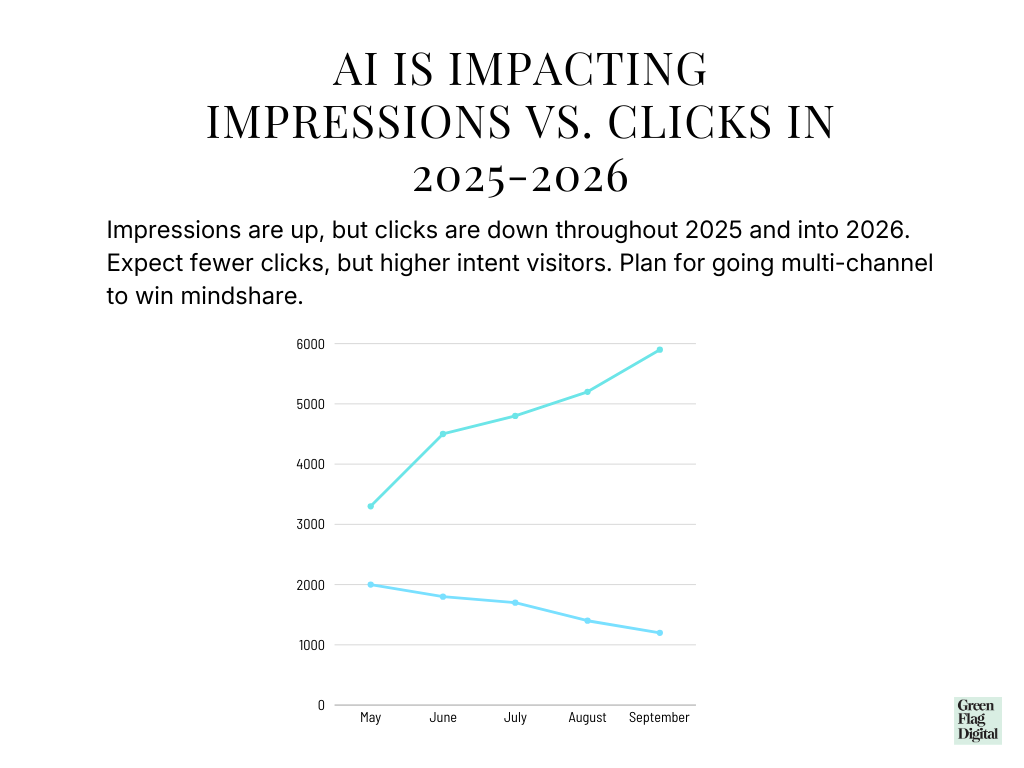
- Google’s AI integrations now reshape how organic visibility works. Snippets? Naw. Instead, today’s “above the fold” Google dominance comes from AI impressions without clicks.
- LinkedIn’s algorithm increasingly favors niche authority over broad publishing, creating smaller pools of more specialized knowledge.
- YouTube operates as a search engine, even for B2B companies. It’s a recommendation engine, too.
- AI chat is only 10% of discovery, but that will only be true for the next year.
Our content strategy services account for up-to-the minute changes in the channels that matter to you, like the reality that top-of-funnel clicks aren’t going to be a reliable entrance to your funnel in the future.
They are also built on 10+ years of serving clients in the foundations of SEO. In other words, we’re good at getting you traffic. But we know traffic for its own sake shouldn’t be your end goal. Revenue built around a tight funnel, even as its location shifts with the times, should.
Practical Implications of Building an Up-to-Date Content Strategy
In-house, we’ve seen an ever-narrowing focus. Clients aren’t asking us to optimize for the newsletter yet, but we’re becoming more thoughtful about each channel, pillar, and offer rather than taking a thin, multi-channel approach.
A tightly scoped content program of comparison pages, or even educational pages, like this glossary we produced for a client in a saturated niche. If it’s served at the right moment when an audience needs answers, this type of content isn’t dead. In fact, right now it’s producing better outcomes than old-school broad, multi-platform pushes or SEO that targets general terms.
Connecting Strategy to Execution
At a practical level, brands should think about updating their own approaches. If you’re considering a new (or first) content strategy, start by thinking about:
- Your highest-value offer
- Your current top distribution channels
- The clearest attribution path you might make from content to SQL
From there, create content clusters that speak to your existing audience, and get started creating a plan for your clients and customers backward from purchase to the decisions they made along the way. Where were they? Who was there to help? What kind of help cut through the noise?
We’re not experiencing a wholesale rewrite of marketing. In fact, human psychology has changed little across generations. It’s where we’re engaging, and which platforms will help elevate your assets, that’s undergoing a shift. Today, you can be an asset to customers without winning any traffic at all.
But how will you know?
And what comes next?
That’s where we come in. If mapping your content strategy with clear attribution and a path forward is moving faster than your marketing department, update it with Green Flag Digital’s help — and keep your content in front of the right people.