Every year, a handful of “State of” reports rise above the noise. These are the reports that capture real behavioral shifts backed by data, packaged up in a visually compelling way. For 2025-2026, the strongest reports are not only summarizing the past year; they’re forward-looking, helping leaders understand where momentum is building, stalling, and what that means next.
Our team has rounded up our favorite “State of” reports from the past year, spanning AI, travel, security, housing, education, migration, and creative work, along with the insights and surprising stats that stood out the most.
1. Zumper – The State of Renting 2025
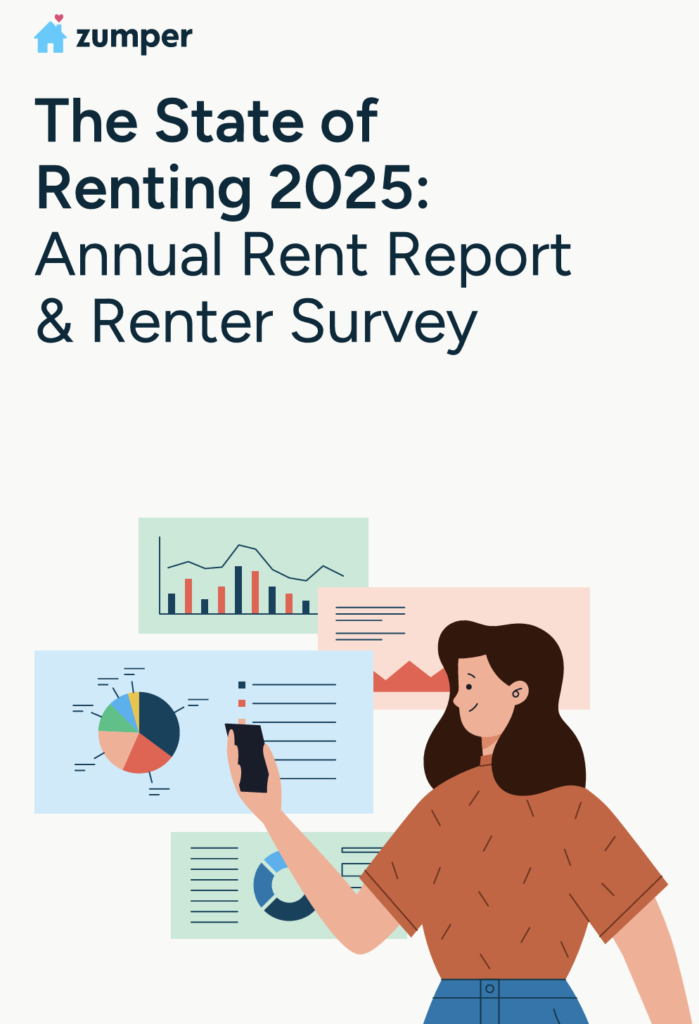
We loved this report because of the clear and impactful insights from 2025, as well as a great summary of predictions for 2026. This report is packed with valuable data insights in a neat and clean way that truly shows how renters are behaving, the two-part story of national rent trends in 2025, and what we can expect for the following year.
A couple of surprising statistics stood out. Over the past five years, renters who only work from home have decreased and also the percentage of people living with roommates has decreased. After COVID, we’ve seen more and more people take on remote work but it seems that’s now starting to decline again. And with rent prices being so expensive all over the country, it’s surprising there are actually less people living with roommates in 2025.
Key highlights from the report:
- The most impactful takeaway from 2025: A midyear inflection where rents unexpectedly turned negative during peak leasing season, signaling a broader cooldown driven by economic pressure that pushed renters to prioritize stability and stay put rather than move.
- AI is rapidly becoming part of the rental journey: AI usage during the rental search more than doubled this year, rising from 4.4% in 2024 to 9.8% in 2025.
- Generational Patterns: The older renters are, the less likely they are to say they ever plan on purchasing a home (the American Dream is no longer tied to homeownership). Millennials have felt the least job security, and Gen Z is significantly more likely to embrace new-age digital tools during their housing search.
- Regional Trends: Southern California rent prices are on the decline and NYC rents reached all-time highs in the first half of 2025, but the market is now recalibrating. Sun Belt markets saw some of the steepest, double-digit declines in 2024, and new construction has pushed vacancy rates higher and depressed rent growth across the Mountain West.
- 2026 Forecast: A construction slowdown will modestly tighten the rental market, especially in coastal, job-dense cities, keeping rent growth restrained while supporting higher renewal rates and longer leases. At the same time, rising costs and shrinking unit sizes will accelerate micro-living, increased use of AI tools by renters and owners, and greater emphasis on high-impact, lifestyle-driven amenities to stand out.
A quote from the CEO at Zumper on The State of Renting Report:
“The impact of new supply was impossible to miss in 2025,” said Anthemos Georgiades, CEO of Zumper. “More units coming online meant more options for renters, and that naturally created a filtering-down effect in older stock. Concessions were plentiful, and renters gained more negotiating power. At the same time, we saw a rental market split in two. While many cities slowed under weaker labor conditions and abundant inventory, high-wage hubs like San Francisco and New York continued to accelerate as demand stayed anchored to strong job centers.”
2. Envato – Beyond Adoption: The State of AI in Creative Work 2026
Envato surveyed 1,780 creative professionals across every discipline, generation, and geography to understand not only whether they’re using AI, but how, where, and why. We loved their report because they not only revealed trends and insights from 2025, but also projected what we plan to see ahead in 2026. They included some creative data visualizations and even went as far as to find out if people tend to disclose whether or not they are using AI in their creative work. The report is very detailed and extensive. Envato covers six themes in the report and encourages readers to skip to the theme that speaks to their particular situation.
Just eighteen months ago, generative AI was a novelty. While today, it’s infrastructure. Envato reveals how nearly half of all creative professionals worldwide now use AI daily—not for entertainment, but for client work.
Key highlights from the report:
- The momentum of AI: Almost half of creative professionals now use AI daily and only 3% actively avoid AI entirely—a number so vanishingly small it suggests complete resistance might not be viable long-term. Nearly 1 in 5 users weren’t using AI at all six months ago. All to say this isn’t gradual adoption, it’s a sprint.
- The Creative Professional vs the Client: 69% of creatives don’t feel very prepared, but recognize that they need to be adaptable in this new world of AI as it continues to develop even quicker. 60% of clients are assuming AI makes work faster and cheaper. They think it’s a prompt and an output, and aren’t recognizing that professional creative work is iterative, strategic, and time-consuming, even with AI.
- Four adoption segments explain the market right now: 49% are high frequency users with AI being core to their workflow. 33% are moderate users, using AI for task-specific things. 15% of users are curious but inconsistent. And just 3% are resistors who continuously avoid it.
- Gen Z creatives feel the most prepared for an AI industry. Younger creatives use AI more, but older generations feel the pressure most.
We asked CEO Hichame Assi: Will 2026 be the year that independent creative AI agents work at an almost full-time capacity within companies?
“Possibly, but the important piece isn’t the technology itself or AI advancements – it’s how creative teams strike the balance of humans working with AI agents to create at scale. The challenge is ensuring human creativity and taste guide AI agents to produce content with character and personality, not homogeneous output. Organizations and companies that find that happy medium will be the ones delivering distinct creative work at scale, versus just churning out content.”
3. moveBuddha – State of Migration 2025-2026
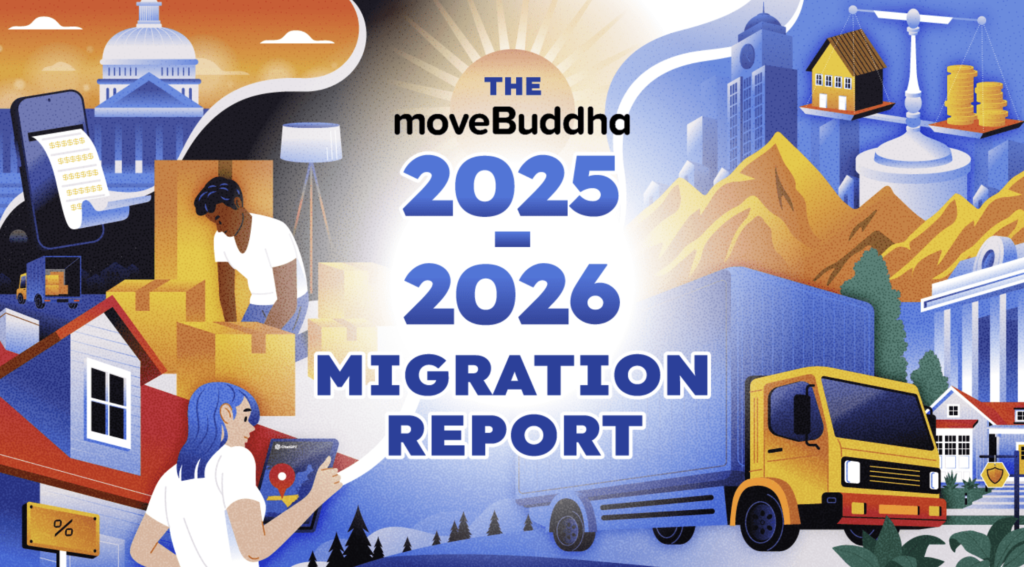
We create a yearly migration report for one of our clients, moveBuddha, using their proprietary data. Their 2025-2026 Migration report reframes the narrative of “it cities” being the go-to places anymore. Micro-destinations and second-ring cities are quietly outperforming expectations. Using forward-looking search data, this report covers a mix of sharp ratios, year-over-year deltas, and a transparent 2026 forecast model that tells a cohesive story: Americans aren’t chasing hype anymore; they’re optimizing for affordability, lifestyle fit, and flexibility, and the data proves it.
A surprising stat we found is that no state pulled in double the number of in-moves versus out-moves in 2025 for the first time since the pandemic. The migration boom has now cooled and interest is spreading out pretty evenly.
Key highlights from the report:
- Micro-destinations gain 10%+ popularity in 2025.
- For the third year in a row, South Carolina is the #1 destination for in-moves compared to exits.
- Alaska has seen the biggest percentage increase in interest this year.
- 5 of the 10 most desirable cities of 2025 are in Florida, which lies outside the top 10 most desirable states.
- In 2026, Alaska’s interest is forecasted to keep rising. It stands to pull in an average of 2.45 new neighbors for every Alaskan calling it quits. South Dakota will see the fastest-growing surge of interest.
We asked co-founder Ryan Carrigan: The data shows Americans are moving less and spreading out more. What do you expect will most define mover behavior in 2026, and how should people interpret the rise of micro-destinations?
“2026 will most likely be less about mass movement to trendy states and more about highly selective, lifestyle-driven decisions. Movers will look for specific pockets that balance affordability, jobs, and quality of life. Expect fewer dramatic booms, more stability, and a continued shift away from prestige metros towards places that simply work for people’s lives and budgets.”
4. HostelWorld – 2025 State of Solo Travel Report
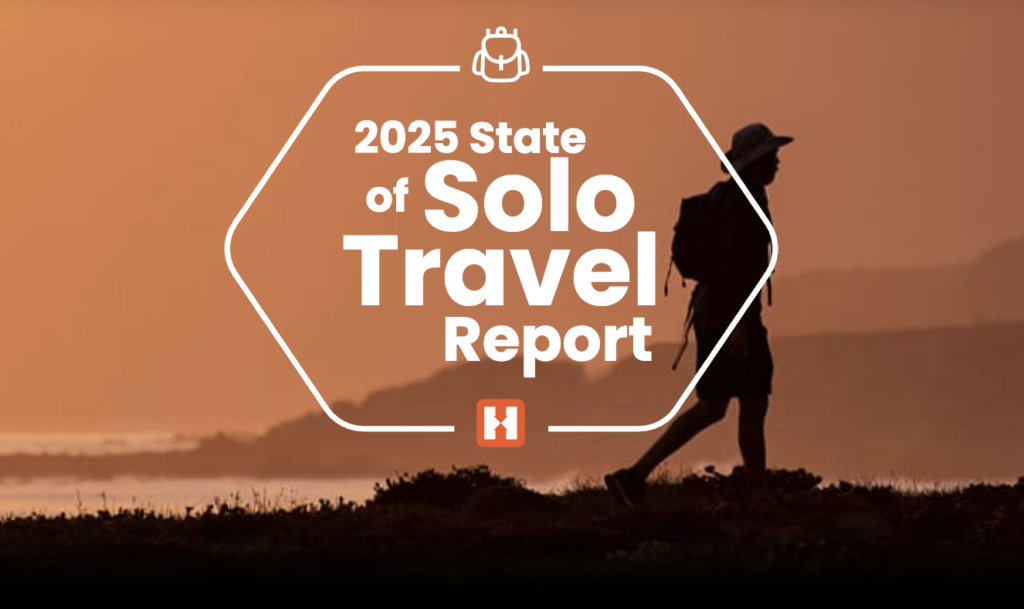
HostelWorld’s State of Solo Travel Report packs an impactful set of data that not only shows what’s trending amongst solo travelers, but can be used as a guide for anyone looking to solo travel in the future. They reveal the true reasons why people are traveling solo, who those people are, and what their biggest takeaways were from traveling to these destinations. Spain scored highest across the board when it comes to the safest and best value destination, as well as the friendliest, and exceeded most expectations.
Once again, we are seeing the rising trend of AI integrate its way into every sector, even when it comes to solo travel. 65% of men and 57% of women are using AI tools to plan or enhance their trips. AI is the new solo traveler sidekick – always ready to help with planning, translation and random “what to do today” ideas at the breakfast table.
Key highlights from the report:
- The solo crowd is young, bold, and addicted to freedom: 66% of solo travelers are 18-30-year-olds, women are more likely to take solo trips, and 35% of solo travelers describe themselves as last-minute bookers.
- The top reason for solo travel was connecting with other cultures, and the best thing people say about solo travel is the freedom and spontaneity it brings.
- The top 3 places to travel remain the same as the previous year: Thailand, Spain, and Italy.
- Asia is blowing up as travel numbers grow double digits, and Latin America experiences a mix of incline with Brazil, Peru and Guatemala, but decline in numbers in Mexico and Columbia.
- Solo travelers were most after cultural and culinary experiences this year.
- Although these travelers arrive solo, a whopping 71% of them are actively looking to meet people upon their arrival. Only 3.7% of people looking for connections met nobody, so the odds are in your favor if you’re looking to meet people whilst traveling alone.
- Safety remains the biggest barrier, but confidence is high, and people are solo traveling anyway.
5. Going – 2026 State of Travel & Flight Deals

Going’s State of Travel Report unlocks flight trends from the past year, different patterns we’re seeing this year and expecting to see next, and provides recommendations on when to book flights for the best deal, with data to back it up. We especially loved the “Goldilocks window” section on this report—check it out if you want to discover when you should be booking your flights to get the best bang for your buck.
One surprising callout from this report is that people are actually traveling less this year. But Going dives deeper into explaining that what they’re seeing is people are getting pickier about where they’re going, and they’re staying there for a longer period of time.
Key highlights from the report:
- The year of “one big trip”: For the first time in years, we saw several months where fewer people flew than the year before. With tighter budgets, busier schedules, and higher airfare, people are getting choosier about where they want to travel and are opting for one big trip versus multiple small trips. But not everyone is slowing down. Despite all this, almost half of Gen Z (48%) ended up taking more trips than they anticipated.
- Big crowds are a deterrent: Over 70% of respondents said that when choosing a destination, they are conscious of whether it deals with overtourism and are opting for places with less of a crowd.
- Asia is growing in numbers while key European cities fall in the ranks. Interest in Asia is expanding beyond Japan to Thailand, South Korea, the Philippines, and Taiwan.
- People are seeking trips that offer a balance of city exploration and the grounding clarity of nature. Cities remain the powerhouse though, with 88% planning to visit a city in 2026.
- 2026 favors premium travelers, not bargain hunters, as airlines prioritize high-margin cabins, loyalty programs, and reliability over cheap fares, making premium economy and business class experiences better and more accessible than ever.
- Don’t sit on your points in 2026—spend them: The value of points is slowly decreasing because loyalty programs keep changing the rules. The value of your points today is almost always higher than the value of your points six months from now, so you’re better off using those points now than trying to save them.
- The “Goldilocks Window”: If you’re paying with cash, the best time to find a great fare is 1-3 months ahead of departure for domestic flights and 2-8 months ahead for international. If you’re planning on using points, it’s quite the opposite. Use your points when airlines release their schedules (about 10-11 months out) or in the final weeks before departure.
6. Recorded Future – 2025 State of Threat Intelligence Report
What stands out most in Recorded Future’s report is how clearly they show threat intelligence evolving from a reactive security input into a strategic business driver. It’s informing technology purchases, risk assessments, and long-term investment decisions. The data shows how deeply embedded threat intelligence has become across security, IT, and executive decision-making.
One surprising statistic was that despite 51% of organizations still rating their threat intelligence maturity as less than advanced, 76% say that threat intelligence influences security decisions at least weekly. 32% say it does so daily, underscoring how critical Threat Intelligence already is to real-world security operations.
Key highlights from the report:
- Threat intelligence maturity is still developing: 51% of organizations rate themselves as less than advanced, but 87% expect their maturity to improve within the next two years.
- Threat intelligence is now a core security investment: Nearly all enterprise organizations view it as critical, with only 7% reporting they have no threat intelligence function at all.
- Dedicated teams are the norm: In 2025, 83% of security teams have a full-time threat intelligence team, signaling continued institutionalization of the function.
- Shift away from part-time models: Compared to 2024, fewer organizations treat threat intelligence as a part-time responsibility (down from 12% to 9%).
- Momentum is moving toward long-term capability building: The data shows steady year-over-year progress toward more formalized, resourced, and mature threat intelligence programs
7. McKinsey – The state of AI in 2025: Agents, innovation, and transformation
McKinsey’s State of AI report gives a clear picture of where we’re headed in the world of AI, and how top-performing companies are using it to their advantage.
One of the biggest takeaways we got from this report is that the highest performing companies are those using AI to their advantage. They are using it in their workflows, experimenting with a variety of AI tools, and setting innovation and growth objectives with AI rather than just efficiency. These high performers are defining their process of integrating AI but also having a human in the loop to validate and ensure accuracy.
An interesting callout we found in this report is that there’s actually varying perspectives on how AI might affect their workforce in the year ahead. There’s lots of discussion about AI taking away people’s jobs. But a plurality of respondents observed little to no change in the number of employees due to their organization’s use of AI in the past year. In most functions, fewer than 20% of respondents reported decreases of 3 percent or more, and smaller shares say their organization’s AI use led them to add headcount within functions. However, moving forward, a median of 30% of respondents expect a decrease in the next year.
Key highlights from the report:
- Most organizations are still in the experimentation phase of AI: Nearly two-thirds of respondents say their organization has not yet begun scaling AI across the enterprise.
- High curiosity in AI agents: 62% of survey respondents say their organizations are at least experimenting with AI agents.
- Positive leading indicators on impact of AI: Respondents report use-case-level cost and revenue benefits, and 64% say that AI is enabling their innovation.
- High performers use AI to drive growth, innovation and cost: 80% of respondents say their companies set efficiency as an objective of their AI initiatives, but the companies seeing the most value often set growth or innovation as additional objectives.
- Half of those AI high performers intend to use AI to transform their businesses and most are using it to redesign workflows.
- Respondents expect a variety of perspectives on employment impact: 32% expect decreases, 43% say no change, and 13% think their workforce will increase.
8. Bessemer – The State of AI 2025

We loved Bessemer’s report because it gives founders an operating map and the benchmarks are concrete. We really love the “galaxies forming vs dark matter” metaphor, that strongly separates what’s firming up (benchmarks, MCP, systems of actions) versus what’s still unresolved (memory reliability, agent trust and security, enterprise ERP replacement timelines).
Bessemer classifies the year of 2023, during the mass release of ChatGPT, to be the AI Big Bang, while 2025 feels like First Light. They predict that 2026 is going to be the year of AI generative video, and we couldn’t agree more. 2024 was the breakout year of generative images, 2025 for voice, and Bessemer predicts in 2026, generative video will become huge and largely advanced.
One surprising stat we found from the report was that AI Supernovas are averaging ~40M ARR in their first year of commercialization and ~125M ARR in year two. They mention that AI Shooting Stars, on the other hand, look more like stellar SaaS companies—finding product-market fit quickly, retaining and expanding customer relationships, and maintaining strong gross margins. Bessemer believes this era will be defined by hundreds of Shooting Stars, making them the most important benchmark for AI founders to aim for.
Key highlights from the report:
- The “Great AI startup” splits into two archetypes: Supernovas, which are explosive ARR ramps but often fragile. And Shooting Stars, which are more “classic great company” behavior with strong retention and expansion, healthier margins, and scaling that looks like SaaS, but faster.
- The new “SaaS growth law” is faster: from T2D to Q2T3. Instead of the SaaS-era “triple, triple, double, double, double,” Bessemer argues the AI-era durable winners look more like quadruple, quadruple, triple, triple, triple. They say this is because AI compresses product development and GTM cycles, and distribution can compound faster.
- There is no cloud without AI anymore: AI is no longer a feature layer, but a default expectation. This means more competition, faster iteration, and less forgiveness for products that wow in demos but don’t stick.
- The battleground is shifting from “systems of record” to “systems of action.” The report’s core enterprise thesis is that AI erodes legacy moats by making migration + implementation dramatically easier.
- Moats are moving to memory, context, and evaluation, not just model choice. The report argues the biggest “sticky” moats in AI products are memory/context that personalizes over time, rigorous evals and data lineage that prove trustworthiness for enterprises, and MCP as the standard protocol that lets agents securely use tools and APIs with permissions and multi-step workflows.
9. Skift x Navan – The State of Corporate Travel and Expense 2026
Skift x Navan’s State of T&E Report does an excellent job of connecting travel directly to business growth, not just cost control. Instead of treating T&E as a back-office function, their report frames travel as a strategic lever, while honestly surfacing where legacy tools, fragmented systems, and half-implemented AI are actively holding companies back. It is both credible and actionable by striking a balance between optimism (travel demand is strong) and practical realism (execution is still broken).
One surprising statistic that stood out is that only 43% of travelers said they were “very satisfied” with the support they received during their last travel issue, despite AI chatbots becoming more common. Also, while 76% of travelers trust AI for basic T&E tasks, only 24% said chatbots always resolve issues quickly and accurately. This explains why most still default to phone and email for help.
Key highlights from the report:
- Business travel is officially back and viewed as mission-critical: Corporate travel importance hit its highest level in seven years, with 90% of travelers saying it’s an essential investment or necessary cost, and 84% agreeing in-person meetings are always more effective than virtual.
- Deal-making has returned as a primary reason to travel: After years of virtual-first selling, “closing a deal” is once again a top-three reason employees travel, signaling the importance of face-to-face interaction.
- Group travel is surging, but systems haven’t caught up: More teams are traveling together for offsites, planning, and events, yet group travel booking remains highly manual, undermining ROI and creating unnecessary admin burden.
- T&E tools are a major friction point despite increased spending: Frustration remains high around policy compliance, expense reporting, customer support, and delayed or inaccessible data. There’s a widening gap between business growth goals and outdated T&E infrastructure.
- AI + automation can unlock major efficiency, but adoption is uneven: From AI-driven booking and support to automated expense reconciliation and real-time analytics, the technology exists to dramatically reduce time and cost, yet many companies haven’t fully integrated these capabilities.
10. Datadog – State of Cloud Security

Datadog released their 2025 State of Cloud Security study, which analyzed security posture data from a sample of thousands of organizations that use AWS, Azure, or Google Cloud. Their findings suggest that ultimately, many organizations continue to leave key resources vulnerable to known exploits and potential attacks. Newer strategies are growing in popularity and offer powerful restrictions but often aren’t enabled by default or introduce additional attack vectors if not configured properly.
The report is unusually strong at turning “cloud security is hard” into specific, measurable posture indicators that map to concrete controls: org-level governance (AWS Organizations), identity-bound containment (data perimeters), credential hygiene, secure-by-default hardening (IMDSv2), and guardrails against public data exposure. It also repeatedly surfaces the real enemy of good security: legacy drift (older accounts, older instances, older credentials), where defaults didn’t apply and the risk quietly persists.
A surprising call-out is that 82% of EC2 instances had exclusively used IMDSv2 in the prior two weeks, even though only 49% enforced it. In other words: a huge chunk of fleets could likely flip enforcement with little to no functional impact, but haven’t. Classic “we’re already doing it, just not enforcing it” security debt.
Key highlights from the report:
- Multi-account is the norm in AWS, but the “management account” is becoming a bigger blast-radius risk. Datadog found 84% of orgs use more than one AWS account and 86% use AWS Organizations, which is great for org-wide guardrails, but 9% now run EC2 instances in the AWS Organizations management account (up from 6% in 2024).
- Data perimeters are gaining adoption, but mostly as “patchwork” resource-level controls. About 40% of orgs use AWS data perimeters via SCPs/RCPs/VPC endpoints/S3 policies, but the most common approach is still S3 bucket policies (32%) and VPC endpoint policies (13%)
- Long-lived credentials are still everywhere, and rotation is slipping. Even with more federated auth, 39% of orgs still use IAM users in some capacity (and 21% rely exclusively on IAM users). Meanwhile, 59% of AWS IAM users have an active access key older than 1 year.
- IMDSv2 adoption is improving fast, but legacy infrastructure is dragging posture down. Overall, 49% of EC2 instances enforce IMDSv2 (up from 32% in 2024), yet only 14% of instances older than two years enforce it.
- Guardrails against public cloud storage exposure are working, but progress is slowing. Only 1% of S3 buckets are effectively public (down from 1.5%), and 83% are covered by S3 Block Public Access, yet adoption is plateauing.
11. Cytactic – CIRM Report

Cytactic released their 2025 Cybersecurity Incident Response Management Report, which interestingly reframes cybersecurity incidents as an operational and leadership problem, not a technical one. Instead of defaulting to “more tools, better detection,” the report consistently shows that internal chaos, misalignment, and unclear authority are the real accelerants of damage.
A shocking statistic from the report was that “70% of security leaders believe internal misalignment caused more chaos than the threat actor itself.” It flips the traditional mental model of cyber incidents. Rather than the enemy being the attacker, this stat shows its actually unclear ownership, late involvement of legal and comms, executive tension, and teams that haven’t practiced together.
This report has 12 chapters to help CISOs, IT security architects, cybersecurity ops leaders, and risk and compliance executives learn how they should be operating and moving forward for the coming year.
Key Highlights from the report:
- Today’s cybersecurity focus has shifted to mastering incident management, bringing order to chaos, limiting damage, and ensuring swift, confident responses.
- Key gaps that stand out: Unclear decision ownership,cross-functional misalignment, the CISO role is evolving, and the AI readiness gap.
- The core weakness is that technology is often treated as a standalone fix rather than integrated into incident response management.
- Most organizations rely on a fragmented stack of tools for detection and containment, with 92% expecting technology to be the first line of defense. However, 67% of leaders report that their tools actually slow them down due to complexity.
- Decision-making delays (54%) and communication breakdowns (44%) are the top inhibitors to a swift response.
- 95% of leaders are planning to invest in AI-supported simulation exercises (shifting to a proactive, technology-driven approach).
12. Quizlet – How America Learns Report 2025

Quizlet’s 2025 report on how America learns is a simple, yet effective demonstration of how AI is shaping the world of education. This report is only 4 pages long and the results are based on their survey of 2,003 respondents (a mix of teachers, parents and students).
It’s no surprise that AI has integrated its way into every industry and has exponentially grown over the past year. We see this same growth within education, as Quizlet found that 85% of teachers and students have used AI technology (up from 66% in 2024).
One surprising stat we found in the report is that teachers outpaced students in the use of AI (87% to 84%). Nearly 90% of teachers are using AI technologies in school, a 23% increase from last year. It will be interesting to see how AI impacts the education system, and how that system will have to shift its structure to adapt to these new AI technologies.
Key highlights from the report:
- 85% of teachers and students use AI technologies in school (up from 66% in 2024)
- The top three use cases students use AI for are summarizing information, researching, and generating study guides or materials.
- 36% of students, teachers and parents believe schools are not adequately preparing students for success beyond the classroom.The top skills respondents think need to be prioritized more are: critical thinking and problem solving, financial literacy, mental health management, leadership skills, and creativity and innovation.
- The top three use cases teachers are using AI for in schools are research, summarizing information, and generating classroom materials, such as tests and assignments.
- AI is the new MVP of learning for college students: 63% of college students said their learning support has been positively impacted, compared to 54% of high schoolers.
13. Cut30 – State of Content in 2026

Cut30 does a great job naming the real shift we’re seeing: content maturity is moving from what you say to how consistently and recognizably you say it. The framing of 2026 as the “format era” reinforces that strong brands win by developing repeatable systems, not chasing one-off viral moments.
One of the most counterintuitive insights was that top-of-funnel content doesn’t need to explain your product or positioning perfectly; it just needs to reach the right persona. That reframes TOFU content as an awareness and alignment tool, not a conversion asset. It also challenges the instinct to over-explain early, which often dilutes clarity instead of building momentum.
Key highlights from the report
- Content evolution: 2024 was about value, 2025 was about story, and 2026 will be about format: Find your angle, become recognizable, then expand your brand.
- Expertise still wins: Despite format shifts, expertise remains the strongest leading angle for content that builds trust and authority.
- Recognition beats raw attention: In overwhelming feeds, people stop scrolling because they recognize you, not just because of a clever hook.
- Archetypes and pillars matter: Brands should choose a clear archetype (expert, artist, wild card, or world builder) and lock in 3–5 repeatable content pillars they can refine over time.
- Series-driven growth: High-performing brands build recurring personalities and signature series with repeatable formats, clear narratives, and batchable production. Then, they expand across mediums like carousels and static posts, as well as other areas like podcast and long-form content.
14. BuzzStream – State of Digital PR Report 2026

BuzzStream released its second-ever State of Digital PR Report, which found that digital PR may be even more effective than last year, yet it’s becoming even more challenging. They interviewed 150+ digital PR professionals and split the report into 10 sections to help readers understand and discover digital PR tactics, challenges, impact, AI involvement, and more.
We really love the additions of expert quotes in Buzzstream’s report. Each quote in their report can be expanded upon, so you can truly see what Digital PR experts are thinking and working through.
BuzzStream found that the #1 digital PR tactic, backed by 95.9% of respondents, is pitching data-led content. We couldn’t agree more. We’ve said it before, and we’ll say it again: use your proprietary data! Ownable, brand-specific data is gold. BuzzStream’s report reinforces why—it helps brands build credibility and gives journalists something they simply can’t get anywhere else.
Key highlights from the report
- According to this year’s study, digital PR primarily involves providing expert commentary, pitching data-driven content, pitching press releases, and creating creative hero content.
- In 2026, data-led content remains the dominant digital PR tactic, with a notable rise in press release submissions (68.8% → 79.1%), likely driven by perceived AI citation benefits.
- More people are manually building media lists this year (risen to 32.4%, up from 25% in 2025) reflecting a lack of trust in media databases.
- When it comes to outreach, personalizing emails and keeping them under 300 words yield the best results.
- AI citation mentions are tracked at 55.4% in digital PR success metrics, a new metric this year, which has also skyrocketed interest in digital PR.
- 68.2% of digital PRs believe that it is more effective than it was 12 months ago—an increase of about 20%.
- For three-quarters of digital PRs (76.4%), AI has fundamentally changed the way they work. 78.4% of digital PR pros track AI visibility for clients. And the tool of choice for tracking is Ahrefs brand radar.
Have a Great State of Report we Should Include?
Great reports move markets, shape decisions, and set the narrative for the year ahead. If there’s an incredible “State of” report we missed, or if your team has one worth featuring, drop us a message below. We’re always on the lookout for work that raises the bar.
Updates Log
- Feb 10, 2026: Added newly released Buzzstream State of Digital PR report
- Jan 6, 2026: First published





Great article! I really appreciate the way you explained everything so clearly – it feels like you put a lot of effort into making it useful for readers. I’ve been exploring different tools and resources myself, It’s been a game changer for me, and reading your post actually gave me even more ideas on how to apply it. Thanks for sharing such valuable insights!