
My current definition of agent swarms are an army of your AI agents and its sub-agents, built around an important goal, orchestrated to run autonomously, with the human guiding and directing towards goals, with or without feedback. Best practices include building agentic loops such that agent swarms can determine if they are achieving goals and self-improve.
Anatomy of a Single AI Agent
It makes sense to look at how a single AI agent is structured before talking about agent swarms.
This image from the Skill, Subagent, or Swarm? A Beginner’s Guide to Making Your AI Agent More Capable Medium post is a helpful visualization.
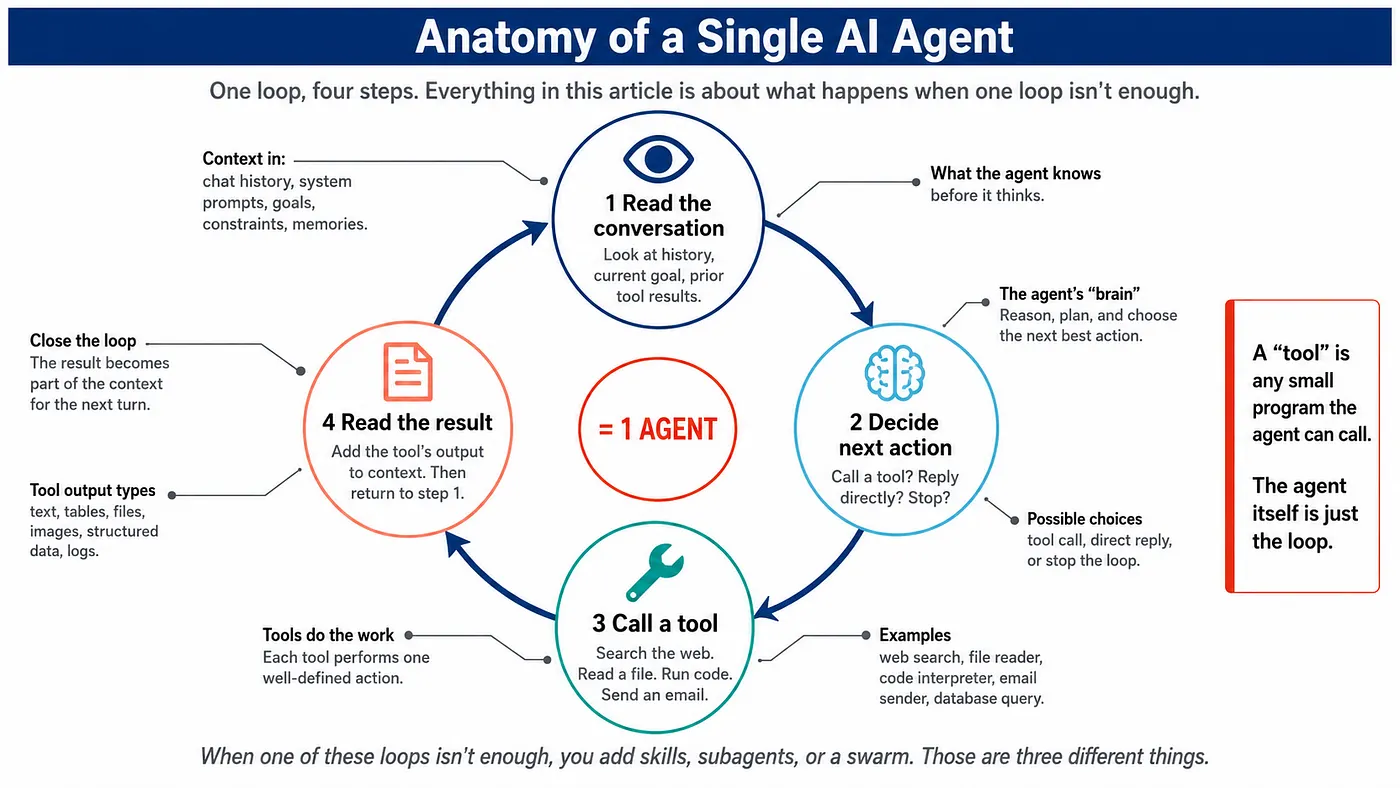
In essence:
- The agent takes in context with chat history, prompts, memories, goals, constraints and data you feed in or make available – and then reads it all.
- With the available information the agent decids what tool to call or how to reply
- Then the agent calls tools via a few ways – web search, folders and files, external connectors, plugins, skills, apps, etc.
- Output from agent is fed back into context – wether an autonomous context folder, a human in the loop, or another agent in the loop.
- There may be automated QA, evals, data checks to steer the AI agent after this loop
It’s important to see the power of the single agent, but also its own loop. In the best scenario, a single AI agent has the context, schedule, tools, and goals such that this single agent can wake, act, and interact with itself and other outside forces. This concept of a loop where it checks its progress against goals and makes adjustments towards bigger goals is a newly evolving area and for the most part developers and AI developers are most equipped to build this out
There are some no-code solutions such as Gumloop, Zaper, N8N, and others – as well as vibe-coded systems built with Codex and Claude Code, directly or via other 3rd parties like Replit and Lovable. New platforms in this stack that help vibecoders get agents live on deterministic systems with probabilistic components include Vercel, Supabase, GitHub, Resend, Astro Build and more.
Build an AI Agent Swarm Easily in CoWork with Fable 5+
This is an easy approach that I like, as a business + marketing practitioner and not a web developer. I believe this gets 85% of the ultimate value in 15% of the time. This is leveraging Cowork + Googleee Drive (but you can sub for Microsoft OneDrive, Dropbox or similar).
So here’s how I like to set it up:
- Build a master folder in Google Drive as the overstory of all your projects that you want to expose to LLMs with a memorable name. This should include all projects connected to your #1 driving goal at your company. If you’re in marketing it might be “20% Q3 SQL Growth” or something similar. If you’re the CEO it might be “Get to #1 marketshare in category by EOY 2026”.
- So I would build a security firewall between info you never want to leak to LLMs, even with SLAs in place, and those docs you are ok exposing. Will leave it up to your legal team and cybersecurity team to interpret this, but safe to say you should anonymize the most secretive company IP.
- So in your shared drive folder, load in a series of input documents in one big folder (can break into subfolders if >10). You can also add raw data files in context with other input files, or in their own folder. Experiment with results you may get in your workflow.
- Then you will mount this drive folder, I’m using Google Drive, to your Claude Cowork conversation as the attached file. You should be sure to have the drive attached to your destop as well as Cowork works best with local files (they seem to be moving towards a web folder).
One step above Cowork – Codex and Claude Code with Github
So I didn’t know about Github much until using it with AI for building custom apps in the last few months. And it’s of course revolutionary for my workflow as a more technical marketer. It tracks all the code changes and commits over time, so you can roll back easily whenever, among other things.
If you’ve ever been a marketer that’s managed web hosting, you may be familiar with git and version control, especially via hosting panels like on WP Engine and Kinsta. Backups for your marketing website are a lifeline, and you see the value if you’ve ever restored a site.
It’s like that with code. So if you’re a business person or marketer that has some experience with HTML, CSS, and Excel formulas, I think you can and shoul really try out Codex and Claude Code and build more robust systems on those platforms.
You can create internal apps and workflows, you can have them build AI workflows for you on other systems like Gumloop, N8N, and notion, and you can also connect directly with connectors.
An easy start is building a Github based to-do list that sees across your entire digital life. Connected to all apps – email, project managers, docs, all of it.
I’m not the expert at building agent swarms on Github – so I’ll be doing more research here. But my conceptual theory of it is thus:
- If you want to build a plug and play workflow system that is scheduled in the cloud, the easiest onramp to this for non-developers is Gumloop, N8N and Zapier as the big 3.
- I like to architect the flow architecture directly in Claude or ChatGPT, then take super-prompts over to those tools and you can build internally on those.
- If you want to have more fine-tuned control and want to own, not rent, the AI agentic workflows connected to the agent swarm, then you’ll want to build this with Codex or Claude Code and have it show you how to host this live – publicly or privately.
- If you’re building internal workflows, you naturally don’t want to expose that to the public web in any way. So for internal company apps, build on internal custom apps and systems or build with enterprise no-code tools.
- However, for non-critical internal apps, and more digital marketing funnels to acquire new leads, it could make sense to build into the cloud directly using additional software.
- Regardless of where you build, you can use Codex and Claude Code via desktop app, mobile app, or web – to archict start to finish.
- You will likely be recommended to build into other software platforms like: Vercel, Cloudflare, Supabase, Resend, and other platforms you may want to connect to.
- The #1 tip is to find the most painful internal company workflow that you just know can be automated with AI and agent swarms, and really keep iterating until it’s a great place, and you can take the prototype to your dev team.
Agent Swarms and LLM Wikis
One idea that popped into my head is that agent swarms could do well if they are connected to an LLM Wiki, like the structure that Andrej Karpathy recommended. In that LLMk Wiki, there are input folders, a glossary, and a wiki structure so it acts like a brain – for the project, yourself, or your company.
